
close
Choose Your Site
Global
Social Media


Views: 0 Author: Site Editor Publish Time: 2026-10-05 Origin: Site


Selecting the wrong cerium salt for industrial or analytical applications leads to poor yields, failed oxidations, or compromised material synthesis. Process engineers and bench chemists often face unexpected bottlenecks when chemical properties misalign with production demands. These errors waste valuable raw materials and disrupt tight manufacturing schedules.
While both are widely used inorganic salts, the fundamental oxidation state difference between Ce⁴⁺ and Ce³⁺ dictates entirely distinct operational roles. You simply cannot treat these compounds as interchangeable bulk materials. Attempting a direct substitution without adjusting your redox pathways risks catastrophic process failure or severe safety incidents.
We offer an evidence-based framework for engineers and procurement teams to evaluate their chemical options. You will learn which compound perfectly aligns with specific stoichiometric requirements, scalability limits, and compliance standards. Read on to master the essential technical nuances separating a highly reactive oxidant from a reliable rare earth precursor.
Oxidation State dictates function: Ceric ammonium nitrate provides powerful Ce⁴⁺ one-electron oxidation; cerium(III) nitrate offers a stable Ce³⁺ precursor for material synthesis.
Solubility and pH: Both offer excellent aqueous solubility, but their behavior in acidic vs. neutral environments drastically alters process design.
Cost and Scalability: Commercial-scale deployment requires factoring in effluent management (ammonium/nitrates) and specific purity grades (e.g., electronic grade vs. technical grade).
Substitution reality: They are rarely interchangeable; swapping them without adding redox steps will break most established chemical pathways.
The core dilemma centers on accurate role identification. You must determine if your process requires an active participant in a redox reaction or a passive source of rare earth metal ions. Making this choice early prevents costly downstream failures. It also streamlines your entire procurement strategy.
Process engineers face constant pressure to optimize chemical pathways. They often inherit legacy protocols demanding specific reagents. Evaluating these protocols requires a deep understanding of core reaction mechanics. You cannot merely look at elemental composition. You must analyze how the compound behaves under operating stress.
Evaluating your chemical requirements involves specific success criteria. You should weigh these factors before finalizing any batch design:
Target reaction yield and kinetic requirements: Determine the exact oxidation potential your reaction needs. Ensure your kinetic windows align.
Downstream separation complexity: Plan for byproducts early. Handling ammonium ions requires different filtration strategies than straightforward nitrate removal.
Economic viability of processing: Compare continuous processing against batch processing. Base this decision strictly on your projected reagent consumption rates.
Many teams ignore the pH constraints of their chosen salt. They dump ceric salts into neutral solutions. This immediately causes cerium oxide precipitation. Another common error involves ignoring downstream effluent profiles. Wastewater treatment facilities struggle heavily when sudden ammonium spikes occur. You must map your entire process from raw material to final waste.
Ceric ammonium nitrate features a specific chemical profile. Its formula is (NH₄)₂Ce(NO₃)₆. This compound stabilizes Cerium in the highly active +4 oxidation state. This elevated state defines its entire functional identity. It wants to accept an electron aggressively. Using ceric ammonium nitrate provides reliable, predictable oxidation results across diverse industries.
Chemists rely on it because it changes color distinctly during reactions. It transitions from a deep, vibrant orange to a pale yellow. This visual feedback simplifies bench-scale monitoring. It eliminates guesswork during critical titration endpoints.
This compound excels in specific operational zones. We classify its primary applications below:
Organic Synthesis: It acts as a highly predictable one-electron oxidant. Chemists routinely use it for oxidizing alcohols and phenols. It also targets side-chain alkyl aromatics effectively.
Microelectronics and Etching: It serves as a critical component in chrome etchant solutions. Semiconductor and LCD manufacturing rely heavily on its precise etching rates.
Analytical Chemistry: Laboratories use it as a standard titrant. It performs exceptionally well in complex redox titrations due to clear colorimetric transitions.
Deploying this powerful oxidant requires strict environmental control. It demands highly acidic environments. Without high acidity, the compound hydrolyzes rapidly. It then precipitates out as solid cerium(IV) oxide. This ruins the active solution. It is also inherently moisture-sensitive. You must guard it against ambient humidity constantly.
Scaling up organic oxidations requires extensive cooling infrastructure. The electron transfer generates significant heat. You should implement automated dosing systems. Slow, controlled addition prevents thermal runaway. Always verify your acid concentration before beginning the main reaction phase. A drop in acidity will immediately stall your kinetics.
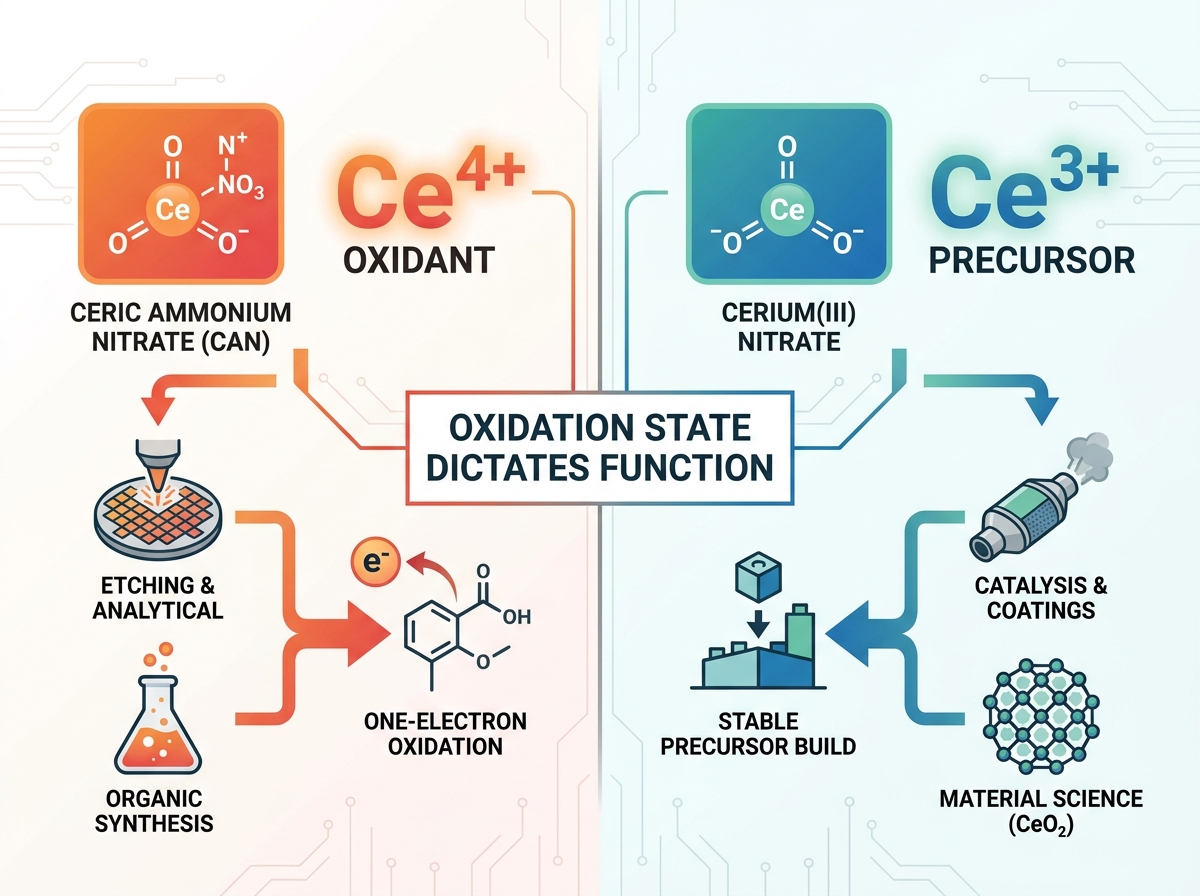
Cerium nitrate offers an entirely different chemical pathway. Its chemical profile is Ce(NO₃)₃. Suppliers typically deliver it as a hexahydrate. It features Cerium in the highly stable +3 oxidation state. This stability makes it an ideal building block. It does not initiate unwanted redox side-reactions. Many catalyst manufacturers depend on cerium nitrate to build robust matrices safely.
The stable nature of Ce³⁺ simplifies process engineering. You can dissolve it readily without aggressive acid additions. It behaves predictably across broader temperature ranges. This makes it a favorite among advanced material scientists.
This stable precursor supports several major industrial pillars. Its predictable behavior ensures high batch-to-batch consistency:
Catalysis: It acts as an essential precursor. Manufacturers use it for automotive catalytic converters. It also forms the backbone of fluid catalytic cracking (FCC) catalysts.
Material Science: It provides the foundation for synthesizing ceria (CeO₂) nanoparticles. It also blends well into other mixed rare earth compound structures.
Corrosion Inhibition: It acts as a green alternative to toxic chromates. Aerospace manufacturers use it extensively in protective surface coatings for alloys.
This compound is highly hygroscopic. It pulls moisture directly from the air. You must implement tightly controlled storage environments. Despite this, it remains easier to handle in solution. It thrives in neutral to slightly acidic aqueous environments. It bypasses the severe acid requirements of its Ce⁴⁺ counterpart.
Managing hygroscopic materials requires strict operational discipline. Follow these protocols to ensure precursor stability:
Monitor ambient humidity inside the storage facility constantly. Keep it strictly below thirty percent.
Store all bulk containers in dedicated climate-controlled zones. Avoid extreme temperature fluctuations.
Seal containers immediately after dispensing. Purge headspace using dry nitrogen if possible.
Test moisture content via titration before initiating critical synthesis batches.
Comparing these compounds requires a multidimensional approach. You must evaluate reactivity, purity, and environmental impact simultaneously. A single oversight in any category jeopardizes the entire project. Engineers must look beyond initial reactivity metrics.
Reactivity dictates the core process flow. Ceric ammonium nitrate is a strong, active oxidant. It will aggressively react with organic solvents if not carefully managed. You must segregate it from reducing agents constantly. Cerium nitrate, however, remains redox-stable in standard conditions. This makes it ideal for high-temperature calcination processes. It survives aggressive thermal cycling intact.
Evaluating chemical grades prevents localized failures. You must choose between Electronic Grade and ACS Reagent Grade carefully. Trace metal impurities drastically affect performance. Elements like Iron or Thorium ruin electronic etching precision. They also poison delicate catalytic doping matrices.
Wastewater management defines modern scalability. Different salts create entirely different treatment challenges. Ceric ammonium nitrate introduces heavy metal (Ce), nitrate, and ammonium loads simultaneously. This combination stresses biological wastewater treatment facilities. Cerium nitrate introduces only Ce and nitrate. This slightly lowers your overall biological treatment complexity.
Evaluation Dimension | Ceric Ammonium Nitrate (Ce⁴⁺) | Cerium(III) Nitrate (Ce³⁺) |
|---|---|---|
Primary Process Role | Active One-Electron Oxidant | Stable Rare Earth Precursor |
pH Requirement | Highly Acidic (prevents hydrolysis) | Neutral to Slightly Acidic |
Effluent Byproducts | Ammonium, Nitrate, Cerium Ions | Nitrate, Cerium Ions |
Reactivity Concern | Exothermic redox with organics | Hygroscopic degradation |
Transitioning from bench scale to commercial production exposes hidden risks. You must anticipate these bottlenecks early. Small thermal fluctuations in a beaker become dangerous runaway reactions in a reactor. Subtle moisture absorption turns a fine powder into unusable sludge.
Risk mitigation requires active planning. You must audit your supply chain for consistency. You should also run accelerated degradation tests on your precursors. This reveals how they behave under sub-optimal plant conditions.
Every process engineer must guard against specific failure modes. Watch out for these common operational bottlenecks:
Exothermic reactions: Runaway risks increase exponentially when scaling up CAN-mediated organic oxidations. Heat removal becomes your primary engineering challenge.
Hygroscopy: Yield inconsistencies emerge quickly. They occur if cerium nitrate hexahydrate degrades. Absorbing excess atmospheric moisture during storage alters your molar mass calculations entirely.
Simplify your decision using clear conditional logic. When doping rare earth nitrates into complex matrices, purity dictates performance. Choose your compound based on strict chemical mechanics:
Choose Ceric Ammonium Nitrate if: Your process requires active chemical etching. Select it for radical initiation. It remains unparalleled for definitive one-electron oxidation.
Choose Cerium Nitrate if: You are synthesizing ceria nanoparticles. Select it when doping rare earth ions into matrices. It serves perfectly when you need a non-oxidizing aqueous cerium source.
Do not finalize your protocol without supplier validation. Request a detailed Certificate of Analysis (CoA) from your suppliers. Target the specific grades your process demands. Next, initiate a bench-scale pilot immediately. Use this pilot to test solubility limits. Measure the exact impurity impact on your final product yield.
Finalizing your chemical procurement strategy requires strict scientific alignment. The choice between ceric ammonium nitrate and cerium nitrate is not a matter of brand preference. It remains a matter of strict chemical necessity. You must respect the fundamental difference between an active oxidant and a stable precursor.
Aligning your procurement specifications with precise process engineering requirements ensures safe scaling. It guarantees regulatory compliance regarding effluent management. It also secures optimal chemical yields batch after batch. Follow these final next steps to solidify your process:
Audit your current reaction pathways to confirm required oxidation states.
Review your wastewater treatment capabilities regarding ammonium limits.
Request sample CoAs to screen for critical trace metal impurities.
Upgrade storage facilities to handle highly hygroscopic rare earth salts.
A: No. Cerium nitrate lacks the +4 oxidation state necessary to drive specific redox reactions. You choose CAN specifically for its oxidative power. You cannot swap them directly. To use cerium nitrate, you must add a powerful external oxidant to convert Ce³⁺ to Ce⁴⁺ in situ. This complicates your process unnecessarily.
A: Both compounds are highly hygroscopic. They require tightly sealed containers. Store them in dry, cool, and well-ventilated areas. CAN possesses unique sensitivities. It reacts strongly to reducing agents and organic materials. You must maintain strictly segregated storage for it. This prevents cross-contamination and ensures total plant safety.
A: Trace impurities severely disrupt semiconductor etching. Heavy metals or alkali metals in ceric ammonium nitrate cause localized surface defects. They also alter chemical etch rates unpredictably. You must strictly adhere to electronic-grade Certificate of Analysis (CoA) standards. Using technical-grade material in microelectronics guarantees extremely high failure rates.


