
close
Choose Your Site
Global
Social Media


Views: 0 Author: Site Editor Publish Time: 2026-10-20 Origin: Site


Precursor selection is a critical variable in advanced chemical manufacturing. It dictates the physical morphology of final rare earth oxides. It also determines the absolute chemical purity of the end product. Furthermore, this choice controls the financial and regulatory viability of scaling up production. High-tech industries rely on these oxides for everything from electric vehicle batteries to precision optics.
Bench-scale synthesis often defaults to highly soluble precursors. Researchers rarely consider the broader operational consequences during early development. Transitioning to pilot or commercial scale requires a strict evaluation. You must assess thermal decomposition byproducts carefully. You must plan for handling hazards. You must ensure seamless integration into existing calcination routes. Ignoring these factors can lead to catastrophic facility bottlenecks.
Choosing between nitrates and acetates is a fundamental decision. You must balance reaction kinetics with strict environmental compliance. Robust health and safety protocols must guide your choice. This article will help you evaluate these precursors. You will learn to optimize scalability and maximize material performance.
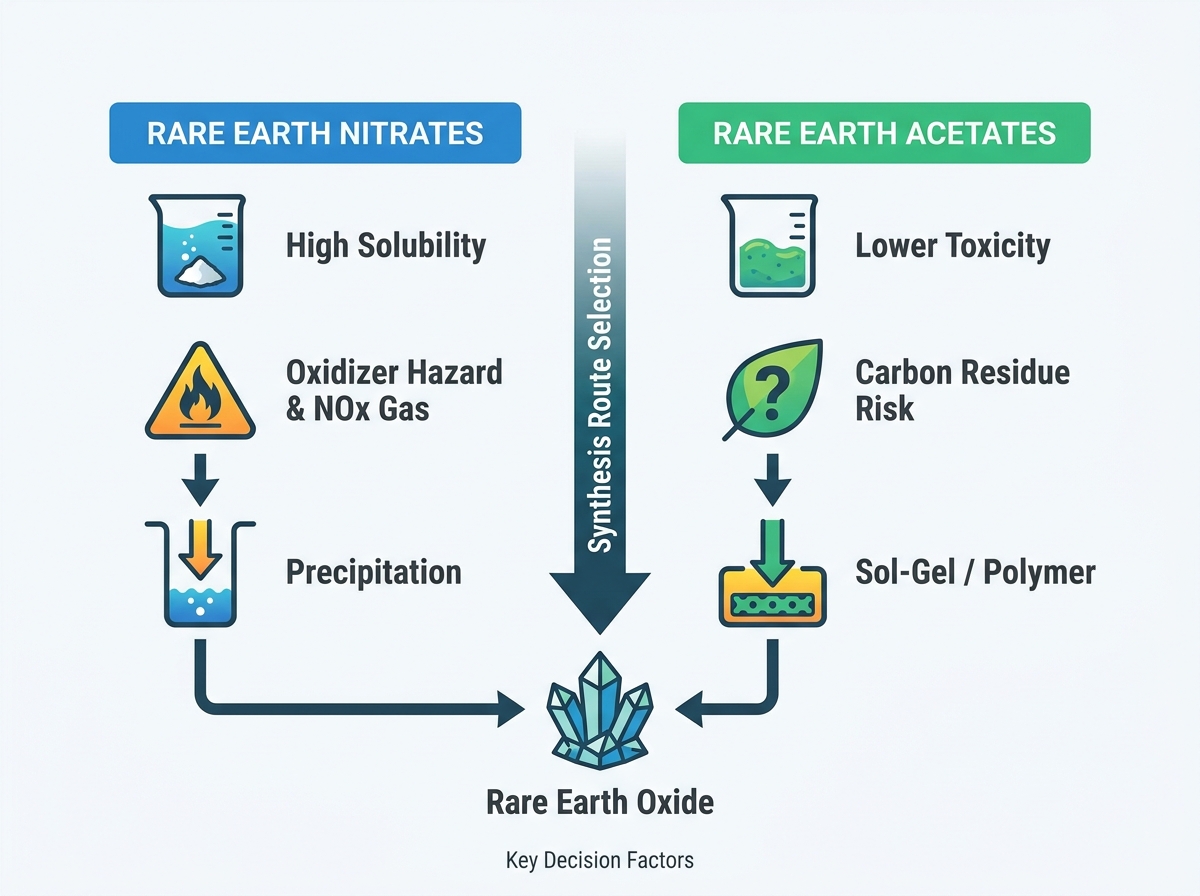
Solubility vs. Safety: Nitrates offer unmatched aqueous solubility but present significant oxidizing hazards and regulatory burdens; acetates provide a safer, less restricted alternative.
Thermal Decomposition Profiles: Nitrates decompose at lower temperatures but emit toxic NOx gases. Acetates require careful thermal management to prevent residual carbon but emit less hazardous byproducts.
Synthesis Suitability: Nitrates are optimal for rapid precipitation; rare earth acetates are highly preferred for sol-gel and polymer-assisted synthesis due to favorable coordination chemistry.
Facility Economics: The upfront cost of precursors must be weighed against the facility costs of handling explosive oxidizers and scrubbing corrosive exhaust gases.
Defining success criteria is your first step in chemical procurement. A successful precursor does more than dissolve quickly in a beaker. It must deliver phase-pure oxides every single time. Repeatable particle size distribution (PSD) is also absolutely vital. Furthermore, you need scalable handling protocols. These elements form the foundation of reproducible manufacturing. Without them, batch consistency becomes impossible.
Consider the scalability bottleneck carefully. Imagine a precursor working perfectly in a 100mL lab flask. Now scale it up to a 1000L commercial reactor. The physics change dramatically. Gas evolution multiplies rapidly during the reaction. Exothermic reactions become much harder to control. Regulatory storage limits often blindside production teams. Heat and mass transfer rates shift significantly. What seemed easy on a benchtop quickly becomes a massive facility liability.
Precursor choice directly shapes downstream material performance. Advanced ceramics require highly specific powder densities. Catalysis demands extremely high surface areas. Optics rely on absolute phase purity to prevent light scattering. Your initial chemical selection dictates these final properties. A poor precursor choice permanently limits the material. You cannot fix bad precursor chemistry during the final milling stages.
Phase Purity: Ensures structural integrity in advanced ceramic applications.
Particle Size Distribution: Dictates the packing density and catalytic surface area.
Handling Protocols: Determines the safety and speed of operator batching.
Engineers often favor rare earth nitrates for their exceptional technical advantages. They dissolve rapidly in water. They also mix exceptionally well into polar organic solvents like ethanol. They boast notably low decomposition temperatures. When you calcine them, they leave zero carbonaceous residue. The final oxide lattice remains perfectly pure. This makes achieving high chemical purity straightforward. Researchers love them for rapid prototyping.
However, the implementation risks are substantial at scale. We call this the "Nitrate Penalty." First, consider environmental, health, and safety (EHS) compliance. These compounds are strong oxidizers. You cannot store them next to standard organic chemicals. They require specialized, segregated storage facilities. They often fall under strict fire codes. This adds substantial regulatory burdens and building costs.
Next, consider emission control during production. Calcination inevitably generates nitrogen oxides (NOx). These toxic, corrosive gases require strict management. You must install expensive wet scrubbing systems. Securing environmental permits is another major hurdle. Facilities often face ongoing emissions monitoring requirements. You cannot simply vent NOx into the atmosphere.
Finally, address the operational handling challenges. Nitrates are highly hygroscopic materials. They absorb ambient moisture constantly. If you store them poorly, water weight fluctuates daily. This leads to severe batch weighing inaccuracies. Stoichiometry suffers if you ignore these changing hydration states. Operators must store them in climate-controlled environments.
Looking for a safer operational route? Rare earth acetates offer a non-oxidizing, lower-toxicity pathway. They excel in advanced sol-gel processes. Their favorable coordination chemistry allows them to form highly stable polymeric networks. This results in superior homogeneity in mixed-metal oxides. They also produce far less violent outgassing during calcination. Operators appreciate the reduced safety risks on the plant floor.
Specific salts stand out for targeted industrial applications. For instance, cerium acetate is a preferred precursor for doping catalysts. It is also excellent for advanced coating applications. Why? Because nitrate residues often poison sensitive catalytic substrates. Acetates bypass this poisoning risk entirely. They integrate smoothly into complex washcoat slurries. Automotive manufacturers rely heavily on them for emission control systems.
However, you must navigate specific implementation risks carefully. Thermal decomposition realities demand rigorous thermal management. Acetates typically require higher calcination temperatures than their nitrate counterparts. Controlled heating ensures complete combustion of the complex acetate ligand. You cannot rush the heating cycle. Rushing causes incomplete burn-off and ruins the batch.
You must manage the carbon risk carefully. If oxygen flow is inadequate, carbon remains trapped. This leaves dark carbonaceous impurities in the final oxide lattice. Carefully tuning the temperature profile during firing prevents this residual carbon. You need precise mass flow controllers for kiln air. You must ensure an oxidizing atmosphere throughout the entire peak temperature hold.
Use a matrix-style comparison approach here for absolute decision clarity. Let us break down how each precursor aligns with core synthesis routes. You must match the chemical behavior to your specific reactor setup.
Precursor Synthesis Compatibility Matrix
Synthesis Route | Nitrates Performance | Acetates Performance | Key Consideration |
|---|---|---|---|
Sol-Gel Method | Poor (violent decomposition disrupts gels) | Excellent (promotes stable polymeric gelation) | Acetates form superior continuous networks. |
Hydrothermal | Excellent (standard aqueous solubility) | Good (acts as a weak base upon hydrolysis) | Acetates aid specific nanostructure formation. |
Coprecipitation | Excellent (rapid, complete dissolution) | Moderate (slower kinetic reactions) | Nitrates react immediately with precipitants. |
Polymer-Assisted | Moderate (can oxidize polymer prematurely) | Excellent (highly compatible with organics) | Acetates prevent uncontrolled exothermic burns. |
In the sol-gel method, acetates generally outperform nitrates. They promote much better gelation across the board. They also avoid the violent decomposition issues common to nitrates. Nitrates tend to disrupt the delicate gel network upon heating. The rapid gas expansion shatters the porous structure. Acetates decompose smoothly, preserving the designed morphology perfectly.
Hydrothermal synthesis presents a more nuanced choice. Both precursors have defined roles here. Nitrates remain common for standard aqueous routes. They dissolve instantly and completely. However, acetates act as weak bases upon hydrolysis. This unique chemical trait aids in forming specific nanostructures. Researchers often exploit this for shape-controlled particle growth. It allows for tuning rod or cube morphologies.
Coprecipitation heavily favors nitrate precursors. Nitrates traditionally dominate this particular space. Their rapid, complete dissolution is ideal. It allows for immediate reactions with common precipitants. You can use oxalates or ammonia with highly predictable results. Acetates often react too slowly for high-throughput coprecipitation. The slower kinetics can lead to uneven particle growth.
Facility upgrades dictate your actual scale-up strategy. Let us examine the capital expenditure (CapEx) impacts first. Nitrates demand Class 3 oxidizer storage. Constructing these explosion-proof, segregated rooms requires massive capital. You need specialized fire suppression systems. You need blast walls. Conversely, acetates require upgrading calcination kilns. You need equipment capable of higher temperatures. You also need strict oxygen flow control to prevent carbon trapping. Both routes require upfront investment, but the building requirements differ vastly.
Next, evaluate operational expenditure (OpEx) impacts carefully. Ongoing operations present very different financial burdens. Nitrates mandate continuous NOx emission scrubbing. Scrubbing chemicals and maintenance run high month after month. You must dispose of the hazardous scrubber wastewater safely. Acetates produce standard carbon dioxide and water vapor during decomposition. You only need standard ventilation systems. This sharply reduces monthly compliance and maintenance expenses.
Finally, evaluate your supply chain and sourcing strategies. Vendor reliability matters immensely for both chemicals. You must evaluate batch-to-batch trace metal purity rigorously. Impurities will destroy the performance of advanced ceramics. Water-of-hydration consistency is another critical metric. Variations in hydration disrupt molar calculations directly. You must conduct Karl Fischer titration to verify water content. Secure a stable supply chain early in the design phase.
Let us clarify the shortlisting logic. Follow these systematic guidelines to match the chemical to your facility. Do not guess; base your decision on these operational realities.
When to Shortlist Nitrates: Choose them when targeting ultra-low carbon purity. They are essential if utilizing aqueous coprecipitation. They make financial sense if you already possess sunk operational infrastructure for NOx scrubbing. Use them when low-temperature calcination is mandatory for your substrate.
When to Shortlist Acetates: Default to them for complex sol-gel processes. Choose them when avoiding oxidizer storage constraints is a business priority. They shine when developing thin-film coatings. Use them where outgassing violence must be minimized to protect fragile structures.
What are your next technical steps? Never guess your thermal parameters. We strongly recommend pilot-scale thermal testing immediately. Conduct thermal gravimetric analysis (TGA). Combine this with differential scanning calorimetry (DSC). Run these advanced diagnostics on both precursor types. Do this before finalizing any long-term procurement contracts. This data will validate your kiln design and confirm your heating profiles.
Neither precursor is objectively superior in all scenarios. Your final choice hinges entirely on the specific synthesis route. Thermal equipment capabilities dictate the winner. Facility EHS limitations also play a massive role. You must align the chemistry with your building's infrastructure.
Relying solely on solubility metrics is a massive mistake. Ignoring decomposition byproducts is highly dangerous. This remains the most common point of failure in oxide synthesis scale-up. You must look beyond the beaker. Think about the exhaust stack and the warehouse.
Take the guesswork out of procurement. Engage with a technical chemical supplier today. Request full Certificates of Analysis (CoA) for your desired compounds. Order sample batches immediately. Begin your TGA profiling to secure your production future safely and efficiently.
A: Manufacturers prefer it to avoid nitrate-induced poisoning of co-catalysts like platinum or palladium. It offers much safer large-scale handling on the factory floor. Furthermore, it integrates much better into advanced washcoat slurries without disrupting the fluid rheology.
A: Yes, they absolutely can. The process requires adequate oxygen flow throughout the heating cycle. You must also use a precisely tuned temperature ramp rate. This careful control allows complete oxidation and removal of all acetate ligands, leaving a pure lattice.
A: Yes, authorities regulate them heavily. Transportation agencies classify them as hazardous materials, specifically oxidizers, under international shipping rules like DOT and IATA. This strict classification directly impacts freight costs, routing options, and procurement lead times.
A: Both precursors naturally form hydrates. Any variations in this hydration state will alter the true molar mass of the bulk powder. Vendors must provide precise lot assays. You need these exact figures to ensure strict stoichiometric accuracy during batch mixing.


