
close
Choose Your Site
Global
Social Media


Views: 0 Author: Site Editor Publish Time: 2026-10-15 Origin: Site


The performance ceiling of solid-state lasers and optical amplifiers is directly dictated by the purity, optical properties, and integration readiness of their rare-earth dopants. Today, engineers and procurement managers must balance absorption cross-sections, thermal management, and raw material characteristics when specifying dopant precursors for advanced glass matrices. Whether utilizing silicate, phosphate, or fluorozirconate, selecting the optimal oxide is a critical first step. We provide an objective, data-driven framework for evaluating two prominent options to ensure your project's success. You will explore key performance trade-offs, practical manufacturing realities, and strict procurement criteria. This comprehensive guide facilitates confident, high-ROI material selection for your engineering teams. By mastering these nuances, you will understand exactly how different precursors influence melt homogeneity, mitigate crystallization risks, and ultimately determine whether a laser system can scale efficiently or safely operate in human-dense environments.
Ytterbium oxide serves as the premier choice for high-power, diode-pumped laser applications due to its minimal quantum defect and broad absorption band.
Erbium oxide remains the industry standard for eye-safe lasers (1.5 µm) and telecommunications (EDFAs), though it requires careful management of upconversion losses.
Controlling erbium oxide particle size and precursor purity is critical for achieving melt homogeneity and minimizing scattering losses in the final glass product.
For many advanced optical applications, a co-doping strategy (Er:Yb glass) utilizes ytterbium as a sensitizer to dramatically improve erbium's pump absorption efficiency.
Defining success in optical glass manufacturing requires a clear understanding of end-user demands. Manufacturers evaluate laser gain media based on several critical performance metrics. We primarily look for high optical conversion efficiency, excellent thermal-mechanical stability, and incredibly low background attenuation. You achieve these desired traits by precisely engineering the host glass matrix. However, the raw dopant material you choose ultimately dictates the absolute performance ceiling.
To understand this, we must examine the basic dopant mechanism. Rare-earth ions like Er3+ and Yb3+ integrate seamlessly into the glass network during the melting phase. They replace specific network modifiers within the atomic structure. This integration transforms an ordinary piece of glass into an active laser gain medium capable of amplifying light. The host material (often silicate, phosphate, or fluorozirconate) provides the structural framework, while the rare-earth ions provide the electronic energy levels needed for laser action.
However, you cannot simply throw oxides into a crucible and expect flawless results. The implementation reality is complex and highly sensitive to material inputs. Your choice of precursor oxide impacts far more than just the final optical emission. It actively shifts the melting temperature of the entire batch. It alters the melt viscosity, which changes how you stir and pour the glass. Furthermore, improper dopant selection directly introduces severe crystallization risks during fabrication. If you use poor-quality oxides or misunderstand their thermal behavior, you risk phase separation. Therefore, mastering the physical and chemical behavior of these dopants is vital before committing to full-scale production runs.
The Yb3+ ion features a remarkably simple two-level electronic structure. This simplicity is its greatest engineering advantage. It entirely eliminates many parasitic processes like excited-state absorption and cross-relaxation, which plague more complex rare-earth ions. Because of this streamlined energy structure, ytterbium oxide ranks as a premier choice for high-power industrial applications.
You will frequently see this material driving 1 µm continuous-wave (CW) lasers used in heavy-duty materials processing, such as metal cutting and welding. The most compelling advantage here is its exceptionally low quantum defect. The energy difference between the absorbed pump photon and the emitted laser photon remains very small. This characteristic yields several specific performance outcomes:
It drastically reduces thermal loading within the glass or fiber core.
It prevents catastrophic thermal lensing, maintaining excellent beam quality.
It significantly lowers the risk of mechanical fracturing under high pump power.
Furthermore, this dopant provides a broad and robust absorption band. It typically absorbs efficiently across a wide spectrum between 900 nm and 980 nm. This broad absorption window makes the material highly compatible with inexpensive, high-power InGaAs laser diodes. You do not need to employ extreme temperature control systems to stabilize your pump diodes. The wide absorption band easily accommodates the natural wavelength drifts caused by temperature fluctuations in standard commercial diodes.
However, critical limitations exist. You cannot apply this material universally. It lacks visible wavelength transitions entirely, meaning you cannot use it for visible-spectrum display or medical lasers. More importantly, its primary emission sits squarely around 1 µm. This specific wavelength easily passes through the human cornea and focuses on the retina, causing instantaneous damage. Therefore, it is strictly not eye-safe. This limits its suitability for open-air telecommunications, autonomous LiDAR, or defense rangefinding where eye safety remains paramount.
In stark contrast to ytterbium, the Er3+ ion boasts a highly complex energy level structure. This complexity yields a highly desirable 1.54 µm emission wavelength. Because the moisture in the human eye heavily absorbs this specific wavelength before it can ever reach the retina, it is inherently eye-safe. Consequently, erbium oxide completely dominates specific, high-value optical sectors.
You will find this material at the absolute heart of Erbium-Doped Fiber Amplifiers (EDFAs). These amplifiers form the backbone of modern global telecommunications, allowing data signals to travel across transoceanic submarine cables without requiring electronic regeneration. Beyond telecom, it powers modern LiDAR systems used in self-driving vehicles and precision dermatology lasers.
When manufacturing these specialized glasses, you face a significant physical risk: powder agglomeration. Raw precursor powder can easily clump together during storage or transit. To prevent melting defects, specifying a precise erbium oxide particle size is absolutely non-negotiable. Glass chemists typically demand sub-micron or nano-scale powder distributions. Fine particles ensure rapid, completely uniform dissolution in the molten glass. If large particles remain clustered, they create microscopic scattering centers. Worse, they form localized concentration zones. These clustered ions interact with each other and cause severe energy quenching, which ruins the optical clarity and amplifier efficiency of your final product.
Despite its industry dominance, erbium possesses notable technical limitations. It suffers from very weak ground-state absorption at the common 980 nm pump wavelength. Engineers must use very long lengths of optical fiber to absorb the pump light efficiently. Moreover, at high doping concentrations, it becomes highly susceptible to concentration quenching through cooperative upconversion. This parasitic process wastes valuable absorbed pump energy, turning it into useless heat instead of usable laser emission, thus limiting the maximum power output of purely erbium-doped systems.
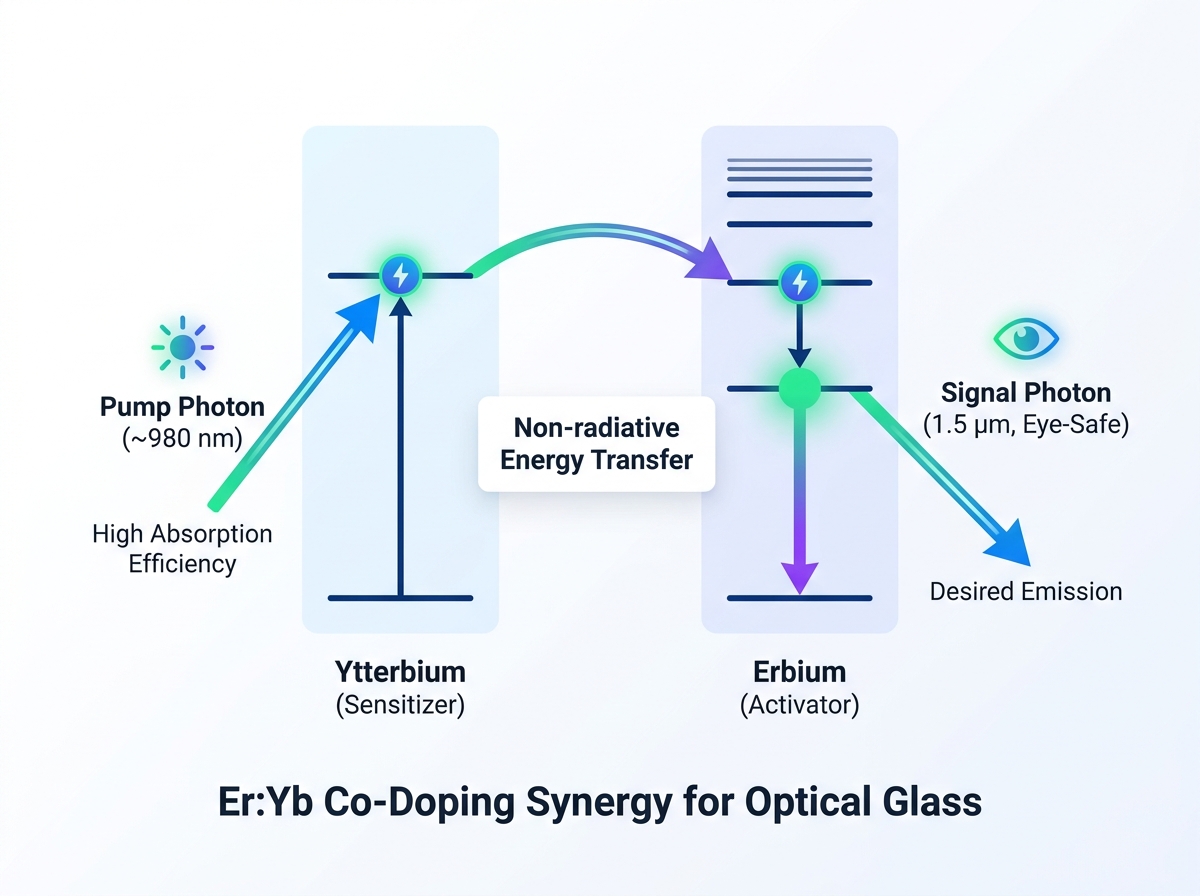
Fortunately, you do not always have to choose between these two materials. Evaluating dopants isn't strictly an "either/or" scenario. Optical engineers frequently utilize Er:Yb co-doped phosphate or silicate glass to capture the best traits of both elements. This technical compromise creates a highly efficient hybrid gain medium, widely used in compact microchip lasers and advanced defense rangefinders.
Let's break down the underlying sensitization mechanism. In a co-doped system, ytterbium acts as a highly efficient primary absorber, commonly called a sensitizer. It easily captures the 980 nm pump light due to its massive absorption cross-section. Once the ytterbium ions are excited, they non-radiatively transfer this stored energy to nearby erbium ions. The erbium ions act as the activators. After receiving the energy from the ytterbium, the erbium ions drop to a lower energy state, emitting the highly desired 1.54 µm eye-safe light.
The host glass matrix plays a crucial role here. Phosphate glass is particularly popular for co-doping because its higher phonon energy physically assists this non-radiative energy transfer. This outcome is transformative for optical engineering. This hybrid approach yields high output power at the eye-safe 1.5 µm wavelength, effectively solving the traditional limitations of erbium-only doping. You bypass erbium's inherently weak pump absorption completely. You also mitigate severe concentration quenching because you can achieve high power output while keeping the actual erbium concentration relatively low. We frequently see this elegant co-doping strategy deployed when engineers need high pulse energies from a very short, compact piece of glass.
When moving from laboratory design to full-scale commercial manufacturing, your raw material procurement specifications directly dictate your operational success. Poor precursor quality will instantly negate brilliant optical engineering. Let's explore the essential criteria you must mandate when sourcing these materials.
First, consider the strict purity requirements. Trace transition metals like iron (Fe), copper (Cu), and nickel (Ni) have a devastating impact on optical efficiency. Even at parts-per-million (ppm) levels, they act as parasitic absorbers, stealing pump energy. Furthermore, hydroxyl (OH-) groups quench fluorescence severely, drastically reducing the laser's lifetime. You must establish a firm necessity for 4N (99.99%) to 5N (99.999%) purity grades. Anything less will ruin your glass performance and cause high rejection rates during quality control.
Purity Grade | Target Applications | Contamination Tolerance |
|---|---|---|
99.9% (3N) | Standard commercial ceramics, non-optical materials | High tolerance for trace metals |
99.99% (4N) | Commercial laser glass, standard telecom fiber | Low (Fe, Cu < 5ppm) |
99.999% (5N) | High-power lasers, advanced EDFAs, space applications | Ultra-low (< 1ppm) |
Next, evaluate powder morphology and flowability. The physical characteristics of the powder matter immensely during batching. Bulk density and specific surface area dictate how well the material physically mixes with silica sand or phosphate compounds. They also influence crucible packing efficiency. Controlling these physical parameters ensures a consistent melt process, eliminating striae and microscopic bubbles.
Moisture management represents another critical logistical hurdle. Rare-earth oxides are naturally hygroscopic. They readily pull moisture directly from the ambient air. You must require strict vacuum packaging protocols and utilize proper climate-controlled storage facilities. We highly advise implementing pre-calcination procedures before batch mixing. This bakes off any accumulated moisture. Water absorption leads directly to catastrophic structural defects and elevated OH- contamination in the final glass matrix.
Finally, establish a rigorous vendor validation process. Do not accept supplier marketing claims blindly. You need a systematic checklist for vetting suppliers:
Request comprehensive Certificates of Analysis (COA) for every single shipment.
Test for lot-to-lot consistency using small trial melts before committing to a main production run.
Verify the supplier's trace element analysis via independent Inductively Coupled Plasma Mass Spectrometry (ICP-MS) testing.
Audit their particle size distribution reports to ensure they use proper laser diffraction measurement techniques.
Mastering rare-earth dopant selection remains fundamental to modern optical engineering. Ytterbium oxide clearly excels in thermal management and quantum efficiency. It completely dominates high-power scaling applications where massive heat dissipation is the primary engineering bottleneck. Conversely, erbium oxide remains absolutely essential for modern telecom networks and LiDAR systems due to its inherently eye-safe emission wavelength. When a specific project demands the high absorption of the former and the safe emission of the latter, Er:Yb co-doping offers the ultimate synergy for advanced solid-state laser systems.
Your actionable next step is clear. Procurement and R&D teams must actively move beyond basic purity specifications. Do not simply order a "99.99% pure" powder off a general catalog. Consult directly with your materials engineers to map out exact operational environments. Customize your particle size distributions and tailor your purity profiles specifically for your chosen glass matrix. By aligning your precursor oxide specifications with your exact manufacturing realities, you will guarantee higher production yields, deliver superior optical performance, and secure a stronger return on your material investment.
A: Large or uneven particles can lead to incomplete melting in the crucible. This creates microscopic scattering centers and localized concentration clusters in the final glass. These clusters cause cooperative energy quenching, which ultimately degrades the amplifier's optical efficiency and beam quality.
A: No. Ytterbium transitions primarily emit around 1 µm, which easily damages the human retina and is not eye-safe. It must be paired with an activator ion, like erbium, to successfully achieve the 1.5 µm eye-safe wavelength.
A: For advanced optical glass manufacturing, a minimum of 99.99% (4N) purity is standard. However, 99.999% (5N) is highly preferred to minimize trace transition metals like iron and copper, which act as severe parasitic absorption centers.
A: Yb-doped glass experiences a significantly lower thermal load due to a much smaller quantum defect—the energy difference between the pump photon and the emitted photon. This makes it vastly superior for continuous, high-power operation without causing thermal fracturing.


