
close
Choose Your Site
Global
Social Media


Views: 0 Author: Site Editor Publish Time: 2026-10-25 Origin: Site


Converting a precursor to a high-performance oxide is rarely a plug-and-play operation. In commercial applications—from chemical-mechanical planarization (CMP) to automotive catalysis—the performance of the final powder is fundamentally bound to how its precursor is processed. While theoretical data provides a baseline, practical calcination variables heavily skew actual oxide yield and particle morphology. Industrial environments constantly introduce uneven ramp rates, dynamic atmospheric conditions, and variable batch sizes. These operational shifts often ruin expected performance metrics. They disrupt downstream integration entirely. Successfully scaling this thermal process requires rigorous interpretation of thermogravimetric data. It demands strict control over thermal parameters at every heating stage. You must also build a clear framework for evaluating suppliers based on verifiable batch consistency. This guide details exactly how to interpret these critical conversion metrics. It provides actionable strategies to secure optimal material properties and stabilize your production line.
Precursor Dependence: Final ceria characteristics (surface area, crystallinity, morphology) are directly inherited from the physical and chemical purity of the cerium oxalate precursor.
Data Interpretation: Practical oxide yield typically hovers around 48–50% for hydrated oxalates; evaluating TGA/DSC (Thermogravimetric Analysis / Differential Scanning Calorimetry) curves is critical for mapping decomposition windows.
Scale-Up Risks: Industrial calcination introduces uneven thermal gradients, increasing the risk of premature sintering and agglomeration compared to lab-scale hydrothermal conversion.
Vendor Evaluation: Shortlisting suppliers requires looking beyond theoretical purity claims and demanding batch-specific particle size distribution (PSD) and trace impurity data.
Operators often blame calcination equipment for inconsistent final powder performance. Poor polishing rates or lower catalytic oxygen storage capacity usually stem from precursor variance instead. Engineers frequently spend weeks adjusting kiln temperatures. They try to fix agglomeration issues. In reality, the root cause lies in the incoming raw material. Achieving a predictable, reproducible particle morphology is the ultimate success criterion. You cannot fix a chemically inconsistent powder through heat treatment alone.
Compared to other rare earth oxalates or carbonates, this specific precursor offers distinct processing advantages. Cerium oxalate generates highly reactive, high-surface-area ceria. It predictably forms specific, active crystal facets upon thermal decomposition. These specific lattice orientations drive high performance in catalytic converters. They also ensure scratch-free surfaces in semiconductor polishing applications. Choosing this optimized starting material secures a distinct competitive edge.
Lower quality precursors demand harsh operational compensations. You will need significantly higher calcination temperatures to force the conversion. Alternatively, you must use much longer post-calcination milling times to break apart hard particle clusters. These aggressive steps drive up facility energy costs. They extend production cycles unnecessarily. Starting with an optimized precursor prevents these costly downstream corrections. It streamlines the entire bulk manufacturing workflow.
Two primary pathways exist for converting precursors into functional oxides. We must evaluate these methods based on scalability and morphological control. The industry standard for bulk production remains thermal decomposition, commonly known as calcination. Facilities rely on programmed temperature profiling in muffle or rotary kilns. Alternatively, hydrothermal conversion offers a liquid-phase, lower-temperature route. Engineers select this method when they require ultra-fine, highly specific nanoparticle shapes. Examples include engineered nanorods or precision nanocubes.
We evaluate these frameworks across specific operational dimensions:
Energy Efficiency: Hydrothermal processing operates at lower temperatures but demands expensive, high-pressure vessels. Thermal calcination requires intense heat, often reaching 500°C to 800°C. However, operators can easily feed material continuously into massive rotary kilns.
Morphology Control: Hydrothermal methods force the atoms into strict, uniform nanostructures. Thermal calcination produces a broader particle size distribution. We can still control the bulk density and porosity of the cerium oxide by adjusting the thermal ramp rate.
Throughput Capacity: Calcination supports hundreds of kilograms per hour. Hydrothermal synthesis remains strictly confined to smaller batch processing.
Conversion Framework Comparison Table
Evaluation Metric | Thermal Calcination | Hydrothermal Synthesis |
|---|---|---|
Standard Temperature | 500°C – 800°C | 120°C – 250°C |
Pressure Requirements | Ambient atmospheric pressure | High pressure (Autoclave) |
Particle Size Output | Micron to sub-micron range | Strict nanoscale uniformity |
Commercial Viability | Excellent for continuous feed | Limited to specialized batches |
While hydrothermal processing produces superior nanoscale uniformity, standard thermal calcination remains dominant. We assume it is the most commercially viable route for over 90% of industrial applications. You simply need to interpret the conversion data correctly to maximize its potential.
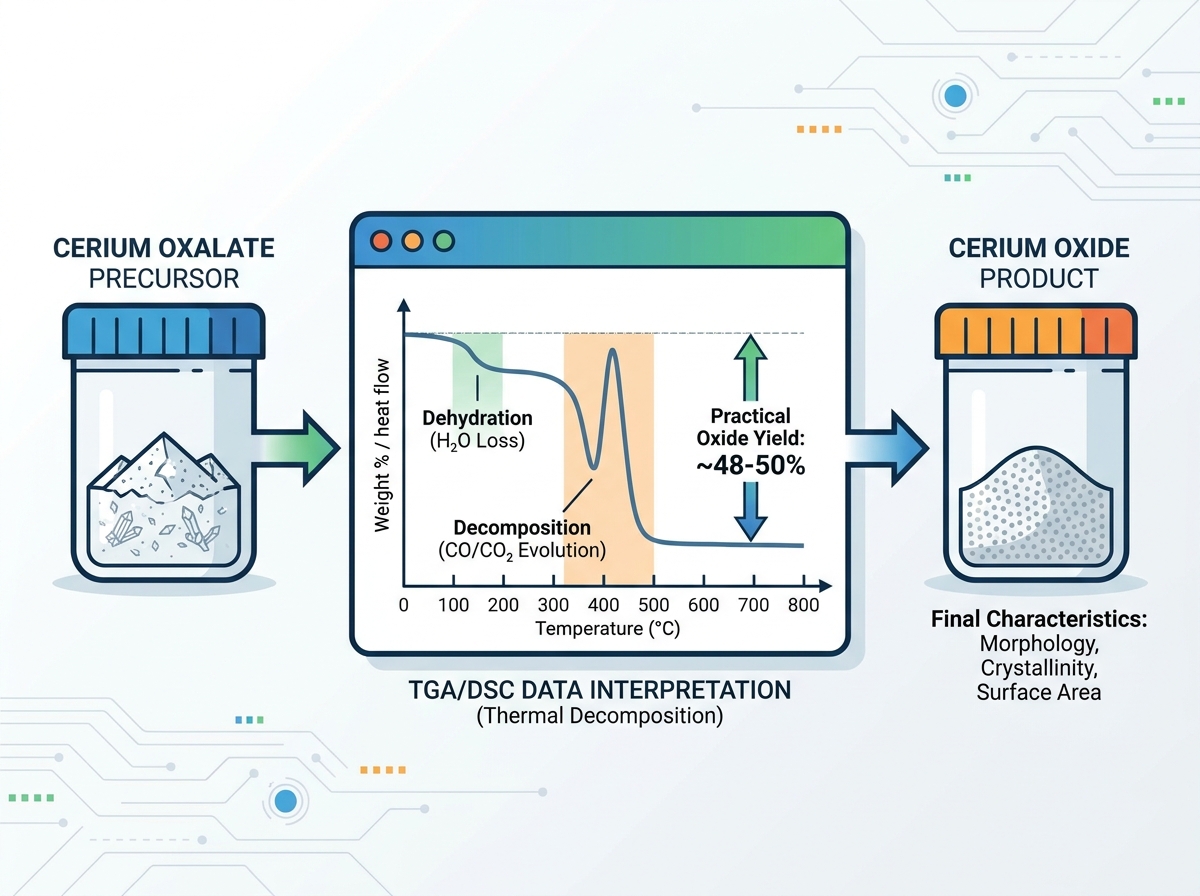
Understanding thermal metrics ensures successful material conversion. We rely heavily on TGA (Thermogravimetric Analysis) and DSC (Differential Scanning Calorimetry) curves. These graphs map exactly how the precursor degrades under heat. The first crucial stage is the dehydration phase. This typically occurs below 200°C. Weight loss in this specific temperature band indicates the removal of bound water hydrates. The actual decomposition phase happens between 300°C and 450°C. Here, you will observe sharp endothermic and exothermic peaks. These peaks signal the rapid evolution of CO and CO2 gases as the molecular backbone breaks apart.
Theoretical yield from a perfect decahydrate molecule is mathematically predictable. The stoichiometric conversion follows strict mass balances based on atomic weights. However, actual practical yield varies significantly on the factory floor. Residual surface moisture and trace environmental impurities alter the final mass retention. Typically, practical oxide yield hovers around 48% to 50% for standard hydrated batches. If you see yields drastically outside this range, you likely have uncalcined carbon or excessive moisture.
You need an evidence-oriented evaluation approach for every shipment. Do not rely on generalized product specification sheets. They represent idealized lab conditions, not your specific drum of material. Read a supplier’s Certificate of Analysis (CoA) carefully. Compare the stated moisture content against theoretical baselines. Buyers must mandate batch-specific TGA curves. This ensures you map the exact decomposition windows for your incoming material. Adjusting your kiln settings based on these specific curves prevents disastrous production runs.
Lab success does not automatically guarantee bulk manufacturing success. Industrial environments introduce severe physical implementation risks. As batch sizes increase in large rotary kilns, poor heat mass transfer occurs. The outer layers of the powder bed heat up much faster than the core. This causes severe localized overheating. The material suffers premature sintering. It forms hard, unbreakable agglomerates. This thermal damage destroys vital BET surface area, rendering the powder useless for high-precision applications.
Another common implementation risk is incomplete calcination. Production managers often rush the temperature ramp rate to increase hourly throughput. This aggressive heating traps residual carbon inside the crystal lattice. Entrapped carbon heavily degrades the powder's final catalytic performance. It also causes severe scratching defects during polishing operations. Careful, staged heating profiles prevent these catastrophic outcomes.
You must mandate specific characterization techniques to verify final material quality:
XRD (X-Ray Diffraction): Use this technique to verify absolute phase purity. It also confirms internal crystallite size via the Scherrer equation. You can detect any unwanted secondary phases immediately.
BET (Brunauer-Emmett-Teller): Mandate this nitrogen adsorption test to measure specific surface area accurately. Ensure the final number strictly matches your intended application requirement.
SEM/TEM (Electron Microscopy): Deploy advanced microscopy to audit particle shape visually. It also reveals agglomeration severity. You can see exactly how the individual grains fused during calcination.
Securing the right precursor requires a strict procurement strategy. Sourcing dimensions must include deep traceability. Ensure ethical and consistent sourcing of raw elements before they undergo precipitation. Regulatory bodies increasingly demand transparent supply chains. Environmental compliance is equally critical. Evaluate how the supplier manages NOx and COx off-gassing. Large-scale thermal decomposition inherently produces these toxic emissions. Your chosen vendor must operate robust scrubbing technologies to remain compliant.
Apply strict shortlisting logic to your vendor pool. Avoid vendors selling basic, one-size-fits-all precursors. Prioritize suppliers who customize initial precipitation conditions. They adjust pH, temperature, and stirring speeds during chemical synthesis. This customization allows them to engineer the precursor to meet your exact required bulk density. It also tightens the final particle size distribution (PSD) before you even apply heat.
Take clear next-step actions before signing large contracts. Request pilot-scale samples ranging from 1 kg to 5 kg. Run intensive internal TGA and calcination trials. Validate the conversion metrics independently. Measure the final BET surface area and evaluate the XRD data. You must confirm these physical properties before committing to commercial-scale tonnage.
Transitioning a raw precursor into commercial-grade powder relies entirely on thermodynamic control and precursor integrity.
Misreading yield data or underestimating scale-up thermal dynamics will directly impact your operational bottom line.
Align your procurement strategy tightly to your internal characterization data.
Demand batch-specific thermal decomposition profiles from your precursor suppliers to ensure predictable manufacturing.
Contact our material engineering team today to request sample CoAs. We can discuss custom calcination profiles tailored specifically for your unique application requirements.
A: The standard practical yield typically hovers around 48% to 50% mass retention. This percentage depends heavily on the exact degree of hydration. Trace impurities and residual surface moisture can also slightly shift this expected yield during bulk processing.
A: They share a direct inverse relationship. Higher calcination temperatures typically lead to larger crystallite growth. This excess thermal energy causes premature sintering, which collapses internal pores and significantly lowers the final BET surface area of the resulting powder.
A: These precursors feature distinct decomposition temperatures and off-gassing profiles. Oxalates generally decompose at lower temperatures, producing a highly porous, reactive lattice. Carbonates require different thermal handling and yield distinct particle morphologies suited for entirely different commercial end-use applications.
A: You must maintain precise ramp rate control to avoid sudden exothermic spikes. Utilizing rotary calcination ensures continuous material movement and uniform heat distribution. Implementing targeted post-calcination milling strategies also helps break down any minor soft agglomerates that form.


