
close
Choose Your Site
Global
Social Media


Views: 0 Author: Site Editor Publish Time: 2026-10-08 Origin: Site


In high-precision optical glass manufacturing, the margin between a premium lens and a rejected batch often comes down to trace elements in raw materials. Microscopic flaws embedded within your chemical inputs can easily ruin an entire production run before molding even begins. Lanthanum glass is critical for achieving a high refractive index alongside exceptionally low dispersion. These physical properties remain essential for crafting advanced camera lenses, highly sensitive medical microscopes, and deep-space astronomical telescopes.
However, selecting the correct chemical specification is not merely a standard technical requirement. It represents a vital procurement decision directly impacting production yields, optical clarity, and bottom-line costs. This comprehensive guide breaks down exactly how to evaluate raw material grades and safeguard your manufacturing process. You will learn how to verify lanthanum oxide purity to eliminate costly defects and mitigate hidden production risks effectively.
Raw material flaws do not disappear once they enter the crucible. Instead, they compound aggressively during the glass melting and annealing process. When you mix different powder components and subject them to extreme heat, trace contaminants disperse evenly throughout the entire glass batch. If a manufacturer overlooks minor chemical inconsistencies early on, they guarantee systemic failures later in the production line.
Certain transition metals and stray rare earth elements act as aggressive colorants. They introduce unwanted absorption bands that destroy optical clarity. You must strictly monitor these common offenders:
You cannot ignore the yield rate economics tied to these colorants. Optical glass production requires extensive downstream processing. Technicians spend days or weeks grinding, polishing, and coating glass blanks. Discovering microscopic defects, subtle color tints, bubbles, or striae after you finish grinding absolutely destroys your production return on investment. Late-stage rejection means you lose both the raw material costs and the expensive labor hours invested in shaping the lens.
Maintaining strict purity controls functions as a critical upfront investment. Spending slightly more capital to guarantee clean raw materials drastically lowers end-of-line rejection rates. This proactive approach protects your operational profitability and ensures every glass blank you cast meets demanding optical specifications.
We primarily use lanthanum to alter how glass manipulates light. Incorporating it allows optical engineers to increase the refractive index of the glass without simultaneously increasing chromatic dispersion. This unique feature-to-outcome relationship forms the basis of the renowned "lanthanum crown" and "lanthanum flint" glass families. High refractive indices mean lenses can bend light more sharply, allowing for thinner, lighter lens elements in complex assemblies.
Chemical impurities actively threaten this delicate optical balance. High-performance glass relies on an intricate network of structural formers. When you introduce contaminants, they disrupt the structural integrity of these carefully designed borate or silicate systems. This disruption triggers a chain reaction during the critical cooling phase:
Furthermore, transmission efficiency relies entirely on material cleanliness. High-purity inputs ensure maximum light transmission across both the visible and near-infrared spectrums. Multi-element astronomical telescopes and high-end photographic lenses stack multiple pieces of glass together. If a single element suffers from a 2% transmission loss due to poor chemical purity, the entire multi-lens assembly suffers a severe performance downgrade. Controlling your material inputs guarantees your lenses remain bright, sharp, and perfectly transparent.
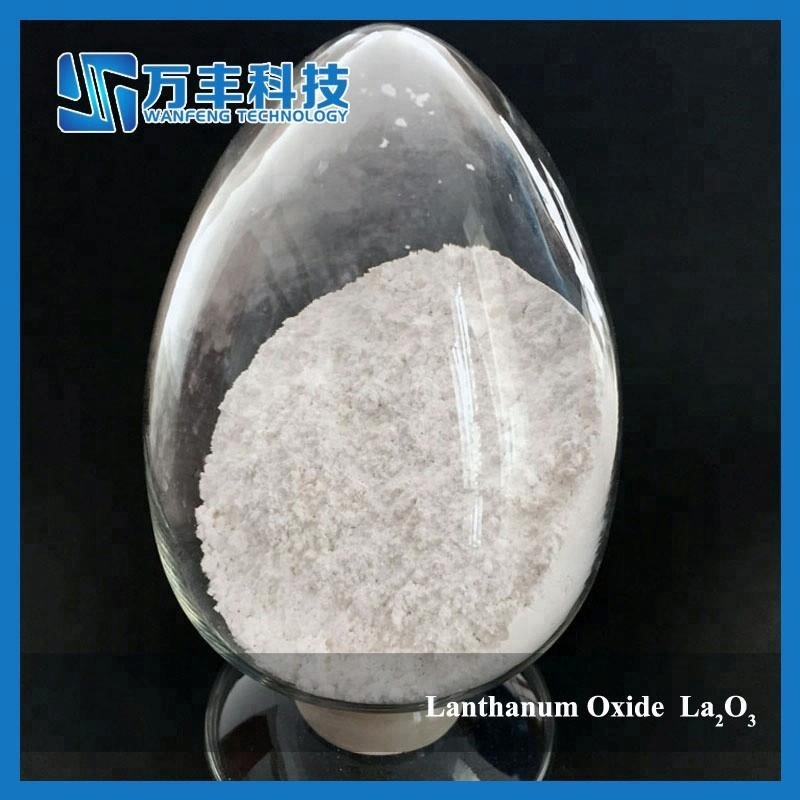
When selecting raw materials, procurement teams typically choose between distinct solution categories: 3N (99.9%), 4N (99.99%), and custom-spec grades. Understanding the practical differences between these tiers prevents both costly over-specifying and disastrous under-specifying.
For most mass-market optical glass manufacturers, standard 99.9% lanthanum oxide powder remains entirely sufficient. However, a 99.9% purity rating simply indicates that the remaining 0.1% consists of other elements. The identity of that 0.1% matters far more than the aggregate number. If the 0.1% consists of innocuous impurities like calcium, silica, or aluminum, the optical performance remains unaffected. If that 0.1% contains iron or neodymium, the batch is effectively useless for high-end optics.
You must upgrade to 4N (99.99%) only for highly specialized applications. Aerospace optics, high-energy laser glass, and certain deep-ultraviolet transmission lenses demand extreme purity. In these extreme environments, even microscopic transmission loss or slight thermal expansion anomalies prove unacceptable.
Procurement departments must conduct a rigorous cost-benefit analysis before purchasing. Moving from a 3N to a 4N specification increases raw material costs exponentially due to the complex chemical refining required. You should constantly align your chosen purity tier with the exact transmission requirements of your end product. Do not pay for 4N purity if you only manufacture commercial binoculars, but never risk using a standard 3N grade for a space-bound telescope.
| Purity Grade | Percentage | Allowable Impurities | Primary Application |
|---|---|---|---|
| Standard 3N | 99.9% | Up to 1000 ppm total | Consumer camera lenses, standard microscopes |
| Optical 3N (Custom) | 99.9% | Strict limits on Fe, Cu, Nd (< 5 ppm) | Professional photography lenses, precision optical tools |
| High-Purity 4N | 99.99% | Up to 100 ppm total | High-energy laser glass, aerospace optics |
Achieving perfect chemical purity does not guarantee a successful glass melt. You face a severe implementation risk known as the hygroscopic threat. Lanthanum compounds eagerly absorb atmospheric moisture and carbon dioxide. When left exposed to ambient air, the powder rapidly forms unwanted hydroxides and carbonates. This chemical transformation fundamentally alters the physical properties of your raw material before it ever enters the furnace.
This hygroscopic behavior leads directly to dangerous weighing inaccuracies. Absorbed water physically increases the powder's overall mass. Imagine your recipe calls for exactly 100 kilograms of lanthanum. If your material has absorbed atmospheric moisture, 5 kilograms of that weight might simply be trapped water. When you melt the batch, the water evaporates away, leaving you with only 95 kilograms of actual lanthanum. This hidden deficit causes the actual lanthanum content in the melt to fall too low, drastically altering the final refractive index of your glass block.
To prevent these costly formulation errors, glass manufacturers must implement rigid storage and handling protocols. Treating standard 99.9% lanthanum oxide powder with extreme care guarantees batch consistency.
| Impurity Element | Maximum Tolerable Level (ppm) | Consequence of Exceeding Limit |
|---|---|---|
| Iron (Fe) | 2 - 5 | Yellow/green tinting, reduced blue light transmission |
| Copper (Cu) | 1 - 3 | Blue tinting, severe light absorption in the red spectrum |
| Neodymium (Nd) | 3 - 5 | Visible absorption bands, localized color distortion |
| Calcium (Ca) | 100 - 300 | Generally innocuous in small amounts, minimal optical impact |
Securing a reliable supply chain requires meticulous vendor evaluation. You cannot build high-precision glass on assumptions. Demand absolute analytical transparency from every prospective supplier. They must provide batch-specific Certificates of Analysis (CoA) for every single shipment. Do not accept generalized or outdated chemical profiles. Ensure the vendor actively tests for your specific "danger" elements, confirming that transition metals like iron remain strictly below 5 ppm.
You must also scrutinize their underlying testing methodology. Look for suppliers utilizing Inductively Coupled Plasma Mass Spectrometry (ICP-MS). This advanced analytical technique provides precise trace metal detection down to the parts-per-billion level. If a supplier relies on older, less sensitive testing methods, they might easily miss hidden contaminants that will ruin your glass melt.
Evaluate the supplier's overall supply chain stability. Pay close attention to their source material consistency. Variations in original mining locations can dramatically change the underlying trace element profile from batch to batch. If refining processes are not tightly controlled, changing a mine source might suddenly introduce new rare-earth contaminants into your supply. A dependable supplier locks in their source origin and maintains rigid separation protocols during refining.
As a final step, never transition immediately to massive tonnage contracts. Always request small sample batches for pilot melts. Run these samples through your complete thermal cycle, cast a test block, and measure the optical results. Only after you physically verify the refractive index and dispersion characteristics should you finalize a long-term procurement agreement.
Sourcing exceptional raw materials for optical glass requires balancing chemical purity, physical handling requirements, and long-term vendor reliability. Microscopic contaminants compound rapidly during production, causing devastating downstream losses if ignored. By understanding how specific transition metals disrupt light transmission and how hygroscopic absorption alters batch chemistry, you can implement robust defenses on the factory floor.
Standardizing your procurement on precisely documented, optical-grade 99.9% purity powders remains the smartest strategy. When you combine high-quality sourcing with strict moisture control protocols—such as pre-calcining and humidity-controlled storage—you achieve the optimal balance of raw material cost and high-yield optical performance. This approach protects your production lines from sudden, unexplainable defect spikes.
Before you place your next material order, gather your technical team. Consult directly with your material engineers to define your exact trace-element tolerances, explicitly outlining limits for iron, copper, and neodymium. Request granular, batch-specific vendor quotes only after you establish these non-negotiable chemical baselines.
A: It allows glassmakers to create lenses with high refractive indices and low dispersion. This unique combination significantly reduces chromatic aberration (color fringing) without requiring excessively thick or heavy glass, making it ideal for precision optical devices.
A: The underlying chemical purity does not naturally degrade, but the powder eagerly absorbs moisture and CO2 from the ambient air. This absorption changes its effective weight and can introduce unwanted hydrogen or carbon into the glass melt if the powder is not pre-treated.
A: Iron (Fe), Copper (Cu), and Neodymium (Nd) are highly detrimental. Even minute, parts-per-million quantities of these elements absorb specific bands of visible light, tinting the final glass and drastically reducing its overall transparency.
A: It must be stored in completely airtight, moisture-proof containers placed within a dry, climate-controlled environment. Utilizing industrial desiccants and double-sealed, vacuum-purged packaging are considered standard industry practices to prevent harmful moisture absorption.


