
close
Choose Your Site
Global
Social Media


Views: 0 Author: Site Editor Publish Time: 2026-08-06 Origin: Site


High-performance NdFeB permanent magnets power everything from electric vehicle traction motors to advanced wind turbine generators. The undeniable foundation of these immensely powerful components rests on a single critical precursor: neodymium oxide (Nd₂O₃). Unfortunately, many procurement teams mistakenly treat rare earth oxides as simple, interchangeable commodities. This dangerous oversight directly leads to unpredictable reduction yields, severe metallurgical defects, and degraded magnetic performance in the final product. Sub-optimal oxides disrupt complex downstream alloying processes and cause massive manufacturing failures.
Our primary goal is to provide materials engineers and buyers with a comprehensive, evidence-based framework for evaluating oxide grades. We will deeply explore how you can accurately assess supplier reliability and meticulously scrutinize chemical parameters. By the end of this guide, you will learn how to match the exact oxide design to specific magnetic applications effectively.
Manufacturers transform precursor oxides into usable metals through a rigorous molten salt electrolysis process. Operators dissolve the powdered oxide into a high-temperature fluoride salt bath. They then apply a direct electric current across the cell. This current strips the oxygen atoms away from the rare earth elements. The process ultimately yields pure liquid metal or a PrNd (praseodymium-neodymium) alloy. Choosing the precise grade of neodymium oxide dictates your manufacturing success during this stage.
The efficiency of this reduction directly influences the ultimate magnetic strength of the final product. We measure this strength as the maximum energy product, or BHmax. High-quality precursor oxides dissolve smoothly into the electrolyte bath. They maintain a stable cell temperature and produce highly pure metallic yields. The resulting metal forms a flawless Nd₂Fe₁₄B crystalline structure during subsequent alloying. This optimal crystal lattice guarantees superior magnetic remanence and excellent coercivity.
Conversely, sub-optimal oxide selection introduces severe operational and financial risks. Poorly refined oxides often contain heavy impurities. These contaminants trigger excessive slag formation within the electrolysis cell. Slag build-up forces the cell to consume significantly more electrical energy to maintain operating temperatures. Energy waste escalates rapidly. Furthermore, physical inconsistencies in the powder lead to uneven dissolution rates. Unmelted oxide particles carry over into the metal casting phase. These trapped particles cause unpredictable magnet shrinkage during the final sintering process. Manufacturers then face high scrap rates and missed production deadlines.
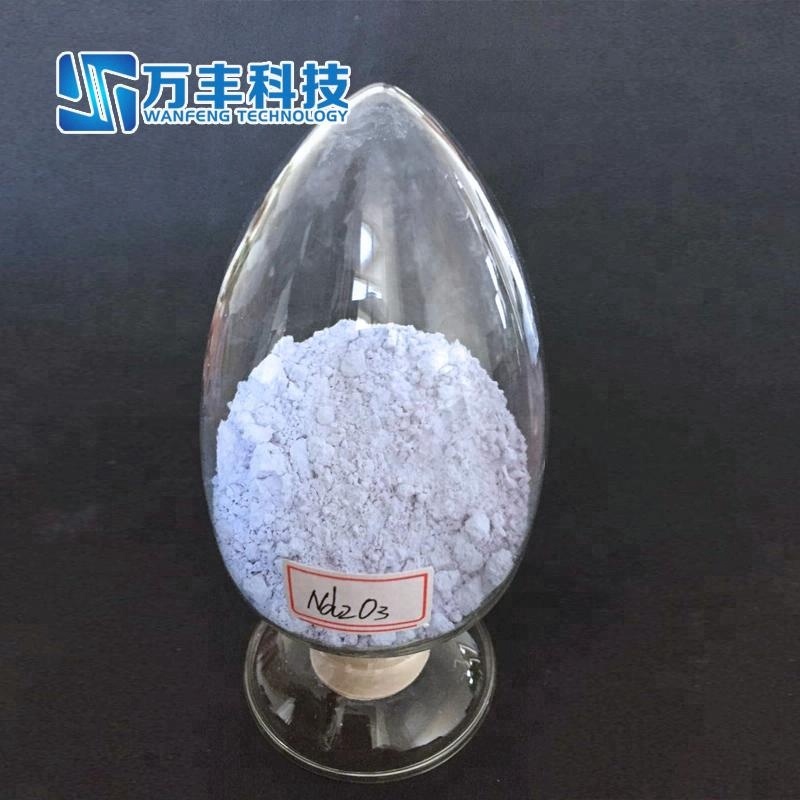
Procurement professionals must clearly distinguish between TREO and relative purity. TREO stands for Total Rare Earth Oxide. It measures the overall percentage of all rare earth elements combined within the powder block. Relative purity, expressed as Nd₂O₃/TREO, identifies how much of that specific rare earth content is actually neodymium. Buyers frequently confuse these two distinct metrics. You must define both numbers clearly on every purchase order.
The market typically offers standard baselines for relative purity. A 99.5% grade serves as the universal industrial standard. A 99.9% grade represents high purity. The 99.99% grade ranks as ultra-high purity. You should only pay a premium for extreme high purity when your end-use demands it. For instance, advanced military sensors or high-grade medical imaging equipment strictly require 99.99% purity. Standard consumer motors simply do not need this expensive upgrade.
Impurities inevitably remain in the powder after chemical separation. We divide these contaminants into two categories: non-rare-earth impurities and adjacent rare earths. Both categories impact the alloy matrix differently.
Non-rare-earth impurities demand incredibly strict limits. Elements like Iron (Fe), Silicon (Si), Calcium (Ca), and Chlorine (Cl) actively degrade the alloy. Silicon promotes the formation of brittle microscopic phases within the magnet. Calcium severely disrupts the electrochemical balance during molten salt reduction. Chlorine causes internal corrosion, weakening the final magnet over time. You must cap these elements at microscopic parts-per-million (ppm) levels.
The following data outlines standard industry limits for common non-rare-earth impurities.
| Impurity Element | Maximum Tolerance (99.5% Grade) | Primary Risk to Magnet Matrix |
|---|---|---|
| Silicon (Si) | < 100 ppm | Creates brittle intergranular phases. |
| Calcium (Ca) | < 50 ppm | Disrupts electrolysis cell efficiency. |
| Chlorine (Cl) | < 200 ppm | Induces long-term internal corrosion. |
| Iron (Fe) | < 50 ppm | Alters baseline magnetic coercivity. |
Adjacent rare earths present a completely different scenario. Trace amounts of Praseodymium (Pr) are highly acceptable. In fact, manufacturers often intentionally blend Pr and Nd together. These two elements share nearly identical atomic structures and magnetic behaviors. However, heavy trace elements like Samarium (Sm) or Cerium (Ce) are strictly prohibited in high-performance grades. They actively dilute the magnetic field strength and lower the maximum operating temperature.
Chemical purity alone cannot guarantee manufacturing success. The physical shape and size of the powder particles matter equally. We measure these physical traits using specific surface area (BET) and the D50 particle size metric. The D50 value indicates the median diameter of the powder grains.
These metrics dictate how fast the powder dissolves in the molten salt bath. If the particles are too coarse, they sink to the bottom of the cell. They form an unreactive sludge. If the particles are too fine, they create massive dust clouds. This dust clogs the extraction ventilation systems and wastes valuable material. Engineers must define strict neodymium oxide specifications to control these physical parameters. A well-optimized morphology ensures a steady, predictable dissolution rate. It stabilizes the entire reduction phase.
Selecting the right precursor requires matching the oxide grade to the final application. Over-engineering your raw materials wastes capital. Under-engineering them guarantees product failure.
Standard industrial grades typically hover around 99.5% relative purity. These off-the-shelf options dominate the broader commercial market. They perfectly fit standard sintered magnets used in everyday consumer electronics. Acoustic devices, mobile phone speakers, hard disk drives, and generic industrial motors rely on these cost-effective grades. The minor trace impurities present at 99.5% purity do not hinder basic magnetic performance. Manufacturers achieve excellent production yields without paying unnecessary premiums.
Advanced engineering projects often demand bespoke solutions. High-temperature applications push magnetic materials to their absolute physical limits. Wind turbine generators face brutal environmental conditions. Electric vehicle (EV) traction motors endure intense thermal cycling. These environments require specific microstructural control to prevent demagnetization at high heat. In these scenarios, manufacturers request tightly controlled PrNd co-precipitates. By co-precipitating the elements early, the supplier guarantees a perfectly homogenous atomic distribution. This homogenous distribution strengthens the magnet's resistance to thermal stress.
Furthermore, proprietary reduction cells often require specialty morphologies. Large-scale refineries customize their calcination profiles to alter the powder's physical shape. A customized calcination cycle changes the bulk density and flowability of the powder. This improves automated feeding systems on the factory floor.
The chart below maps application categories to their recommended precursor designs.
| Application Segment | Recommended Grade | Engineering Justification |
|---|---|---|
| Consumer Electronics | Standard 99.5% Nd₂O₃ | Balances cost with adequate magnetic output. |
| EV Traction Motors | Custom PrNd Co-precipitate | Enhances thermal stability and microstructural uniformity. |
| Advanced Medical Imaging | Ultra-High 99.99% Nd₂O₃ | Eliminates signal noise caused by trace metal anomalies. |
Procuring high-quality material solves only half the puzzle. You must carefully protect the powder once it arrives at your facility. Neodymium oxide possesses highly hygroscopic properties. It aggressively absorbs moisture and carbon dioxide directly from the ambient atmosphere.
When the powder absorbs moisture, a chemical reaction occurs. The oxide transforms into neodymium hydroxide or neodymium carbonate. These new compounds spell disaster for downstream processing. When fed into a high-temperature electrolysis cell, hydroxides forcefully release hydrogen gas. This outgassing disrupts the electrolyte bath, spatters molten salt, and degrades the final metal purity. You must manage this real-world operational risk proactively.
Strict packaging requirements mitigate moisture absorption. Do not accept standard bulk bags for long-term storage. Follow these packaging best practices instead:
Beyond physical handling, procurement teams face the hidden threat of "quality fade." Quality fade occurs when a supplier slowly relaxes their standards over the course of a long-term contract. The first few deliveries exceed expectations. Slowly, impurity levels begin to creep upward. Particle sizes become inconsistent. Supplier complacency represents a massive risk. You must combat this phenomenon through rigorous incoming Quality Control (QC). Never skip batch testing. Test every single delivery against your baseline specifications, regardless of the supplier's historical reputation.
Securing a resilient supply chain requires a rigorous vetting process. You cannot evaluate a supplier based on price quotes alone. You must investigate their technical capabilities, their analytical transparency, and their corporate responsibility. Follow these structured steps to evaluate potential partners properly.
Matching the right precursor design to your magnetic material requires careful strategy. You must precisely balance chemical purity requirements with physical morphology constraints. Furthermore, you must secure robust supply chain stability to protect long-term production. Treating these critical oxides as generic commodities only invites manufacturing chaos and degraded magnet performance.
We advise procurement teams to take immediate action. Begin by auditing your current Certificates of Analysis. Identify any creeping trace element impurities. Next, define strict impurity thresholds tailored directly to your specific reduction technology. Finally, reach out to vetted partners and request highly controlled sample batches for rigorous pilot testing. Proactive material science secures your competitive advantage.
A: Typically >99.5% to >99.9%, combined with strict control over non-rare-earth trace elements that cause grain boundary defects.
A: Yes, PrNd (Praseodymium-Neodymium) oxide is a standard precursor for most commercial NdFeB magnets, offering comparable magnetic properties at a better cost-efficiency than purely separated Nd.
A: While chemically stable, its hygroscopic nature dictates that shelf life depends entirely on packaging integrity. Once exposed to ambient air, it must be used immediately or re-calcined before reduction.


