
close
Choose Your Site
Global
Social Media


Views: 0 Author: Site Editor Publish Time: 2026-10-01 Origin: Site


Sourcing rare earth compounds requires a delicate balance in today's volatile industrial market. You must weigh stringent purity specifications against long-term supply chain stability. Inconsistent material quality directly impacts downstream manufacturing yields. It also threatens strict regulatory compliance and overall end-product viability. Whether you synthesize life-saving phosphate binders for clinical use or develop advanced optical glass, your raw materials dictate success. The exact specification of your lanthanum carbonate determines whether your application scales profitably or fails in quality control.
This comprehensive guide breaks down the precise purity frameworks you need to know. We explore application-specific industry standards and critical raw material sourcing criteria. You will learn exactly how to evaluate, audit, and shortlist a reliable supplier for your critical manufacturing operations.
Understanding specific end-market requirements helps you frame technical use cases. Different industries demand wildly different material specifications. You must align your procurement strategy directly with your intended business outcomes.
Medical manufacturers frequently use this compound as an active pharmaceutical ingredient (API). It serves as a potent phosphate binder. Doctors prescribe these binders to treat hyperphosphatemia in patients suffering from end-stage renal disease. The mechanism is straightforward. The compound binds to dietary phosphate in the gastrointestinal tract. This process forms highly insoluble complexes. The body then excretes these complexes safely.
When evaluating suppliers for clinical applications, you must apply a rigorous lens. You will navigate strict FDA regulatory frameworks. Bioavailability requirements remain absolute priorities. Strict toxicity limits require zero tolerance for heavy metal contamination. A single compromised batch can derail clinical trials and trigger massive recalls.
Best Practice: Always mandate comprehensive elemental impurity testing conforming to ICH Q3D guidelines before accepting any medical-grade batch.
The optical industry utilizes this rare earth compound as a specialized dopant. Incorporating it into glass matrices significantly improves the refractive index. It also enhances chemical resistance and maintains thermal stability across varying temperature extremes. Specialized optical lenses, prisms, and advanced camera systems rely on these enhanced physical properties.
Your primary evaluation lens here focuses on physical morphology. Consistency in particle size distribution (PSD) dictates success. Uneven particle sizes cause incomplete melting. This inconsistency creates microscopic optical defects. You must ensure your supplier delivers highly homogeneous powders to maintain optical clarity.
Industrial sectors leverage this material as a vital precursor. Refineries use it to manufacture fluid catalytic cracking (FCC) catalysts. These catalysts improve gasoline yields during petroleum refining. Additionally, municipal and industrial plants use it for high-capacity phosphate removal in wastewater treatment.
Evaluation in this sector prioritizes surface area metrics. High surface area translates directly to higher chemical reactivity. You must also evaluate cost-to-performance scalability. While extreme purity might not be as critical as in pharma, consistent reactivity guarantees efficient industrial throughput.
Commodity compounds often lack the rigorous technical specifications required for modern manufacturing. High-grade commercial raw materials stand apart. Understanding these differences protects your manufacturing investments.
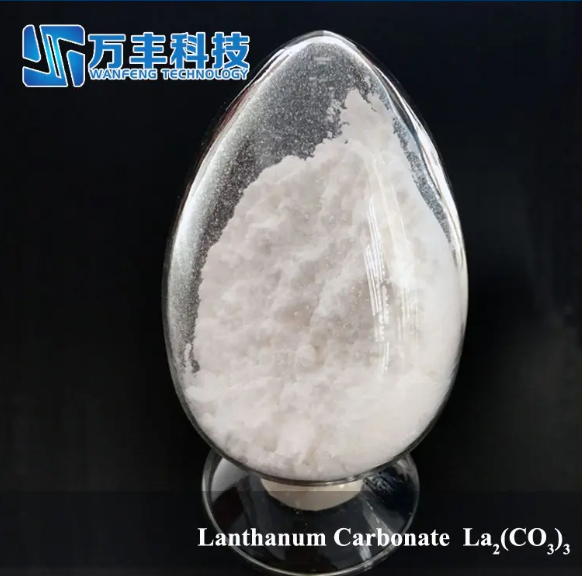
A minimum 3N purity standard prevents unwanted chemical reactions. Using 99.9% lanthanum carbonate powder excludes competing rare earth elements. You actively prevent Cerium (Ce) or Neodymium (Nd) from disrupting your chemical matrices. Furthermore, this baseline strictly limits dangerous heavy metals like Lead (Pb) and Arsenic (As). Eliminating these impurities ensures your sensitive chemical syntheses proceed exactly as engineered.
Chemical purity only tells half the story. Morphological parameters profoundly impact processing efficiency. Bulk density dictates how well the powder packs into reactors or shipping containers. Loss on ignition (LOI) measurements reveal moisture content and volatile substances. Precise hydration states directly affect active weight calculations. If you ignore these physical characteristics, your downstream dosage and mixing ratios will fail.
Investing in 99.9% purity reduces downstream purification costs. Cheaper, lower-grade materials seem attractive initially. However, they introduce contaminants. You must then spend excessive time and resources purifying your final product. High-purity inputs minimize batch rejection rates. In highly regulated manufacturing environments, maximizing yield easily justifies the premium price of 3N purity materials.
Standard Purity Parameters Comparison
| Parameter | Standard Industrial Grade | 3N Commercial Baseline (99.9%) |
|---|---|---|
| Total Rare Earth Oxides (TREO) | > 40% | > 50% |
| Non-Rare Earth Impurities | Variable | Strictly controlled (< 0.1%) |
| Heavy Metals (Pb, As) | Moderate limits | Ultra-low parts per million (ppm) |
| Particle Size Distribution | Broad | Narrow and controlled |
Navigating global compliance realities challenges even experienced procurement teams. You must demonstrate authority and precision when managing material qualifications.
Medical-grade applications face the highest regulatory scrutiny. You must navigate complex FDA draft guidances carefully. Manufacturers must operate within strict Current Good Manufacturing Practice (cGMP) environments. Furthermore, your raw materials must align with United States Pharmacopeia (USP) monographs. Complete supply chain traceability is non-negotiable. Auditors will trace your material back to the original refining facility.
Industrial applications carry their own stringent standards. Facilities often require ISO 9001 and ISO 14001 certifications. If you supply European markets, you must secure REACH compliance. Environmental handling protocols dictate how workers store, transfer, and dispose of the material. Failing to meet these standards invites severe operational penalties and blocked market access.
The Certificate of Analysis represents your primary defense against substandard materials. You must learn what to look for on a CoA. Some suppliers manipulate data by presenting theoretical limits instead of actual batch results. You must demand transparent, third-party validated elemental analysis. Require actual Inductively Coupled Plasma Mass Spectrometry (ICP-MS) testing results.
Common Mistake: Accepting a "typical specification" sheet instead of a batch-specific CoA. Always demand the exact testing data for the specific lot arriving at your loading dock.
Procurement teams face significant actual risks when sourcing rare earth materials. Theoretical specifications mean nothing if the physical supply chain collapses.
Global rare earth mining and refining operations suffer from extreme geographic concentration. A handful of regions control the majority of processing capacity. Geopolitical factors directly impact pricing stability. Export quotas and trade policies alter lead times overnight. You must build buffer stock and qualify secondary suppliers to survive these macro-sourcing bottlenecks.
The implementation reality is harsh. A successful 1kg laboratory sample does not guarantee a compliant 1,000kg commercial delivery. Scaling up refining processes introduces new variables. Temperature fluctuations in massive reactors can alter particle sizes. You must audit a supplier's scale-up capabilities thoroughly. Ask for historical batch data covering multiple large-scale production runs.
You must address the hygroscopic nature of lanthanum carbonate. The powder eagerly absorbs moisture from the atmosphere. This moisture absorption alters the active weight and degrades material integrity. You must enforce mandatory packaging requirements.
We recommend the following packaging standards:
Maintaining these integrity standards during ocean transit prevents costly material spoilage.
Converting technical requirements into commercial success requires a clear, actionable evaluation framework. Follow this systematic approach to mitigate financial risk and drive qualified conversions.
Begin by matching the supplier’s baseline CoA with your internal R&D or clinical trial mandates. Do not assume minor deviations are acceptable. Cross-reference their maximum impurity limits against your strictest internal requirements. If their standard product fails your baseline, move on quickly. Do not waste time trying to force a generic supplier to meet ultra-high purity standards.
You must investigate the operational reality of your shortlisted candidates. Check for vertically integrated supply chains. Suppliers who control their raw mineral sources offer greater price stability. Demand transparent refining locations. Ensure they possess dedicated, in-house quality control infrastructure. If a supplier outsources all testing, they lack immediate control over production anomalies.
Design a staged procurement plan. Never jump straight from a successful lab test to a massive commercial contract. Follow a rigid scale-up protocol to mitigate regulatory risks.
Initiate a technical consultation once you identify a strong candidate. Provide them with your specific tonnage requirements. Detail your precise purity specifications. Request a custom quote based on actual delivered volumes. Clear communication at this stage sets the foundation for a reliable, long-term partnership.
The selection of rare earth compounds cannot be reduced to unit price alone. Purity standards, regulatory adherence, and supply chain sovereignty act as the true drivers of your long-term success. Compromising on material quality inevitably leads to downstream production failures and regulatory breaches.
We highly recommend ensuring your chosen supplier provides transparent testing data. They must demonstrate reliable scale-up capacity and offer application-specific technical support. A true manufacturing partner will help you navigate the complexities of material handling and compliance.
Take action today to secure your supply chain. Request a comprehensive technical data sheet from your prospective suppliers. Submit your internal CoA requirements for their immediate review, or contact a specialized engineering consultant to secure a custom quote tailored to your exact manufacturing needs.
A: Pharmaceutical-grade demands ultra-low heavy metal limits and stringent FDA traceability. Manufacturers produce it in strict cGMP environments. Industrial-grade focuses primarily on particle size and reactivity. It allows slightly higher trace impurities since applications like catalysis or water treatment do not involve human ingestion.
A: High moisture content alters the material's active weight. This directly skews downstream dosage calculations and mixing ratios. Since the powder is highly hygroscopic, excess moisture also causes clumping. This degrades flowability and creates massive handling issues inside industrial blending equipment.
A: You must test for competing rare earth elements like Cerium and Neodymium, which disrupt chemical matrices. Additionally, you must screen for toxic heavy metals including Lead, Arsenic, and Cadmium. These heavy metals trigger immediate batch rejections in regulated medical or optical applications.
A: Moving from lab sample approval to full commercial delivery typically takes 8 to 12 weeks. This timeline accounts for raw material refinement, custom batch production, comprehensive ICP-MS quality testing, and global ocean freight transit from concentrated rare earth processing hubs.


