
close
Choose Your Site
Global
Social Media


Views: 0 Author: Site Editor Publish Time: 2026-10-30 Origin: Site


Procurement teams often face a critical bottleneck. They purchase raw alloying agents instead of ready-to-machine materials. This misalignment stalls entire manufacturing lines. Imagine buying a highly concentrated additive when your machines expect ready-to-cut billets. Purchasing the wrong material format leads to severe production delays. It wastes massive capital on high-cost metals. Worse, it risks structural failures in your final application.
We aim to clear up this costly confusion. This article provides a strict technical and financial evaluation framework. You will learn how to confidently decide between concentrated master alloys and ready-to-use finished alloys. We break down required metallurgical capabilities. We examine supply chain realities. We evaluate high-stakes processing risks. By the end, you will know exactly what you are buying.
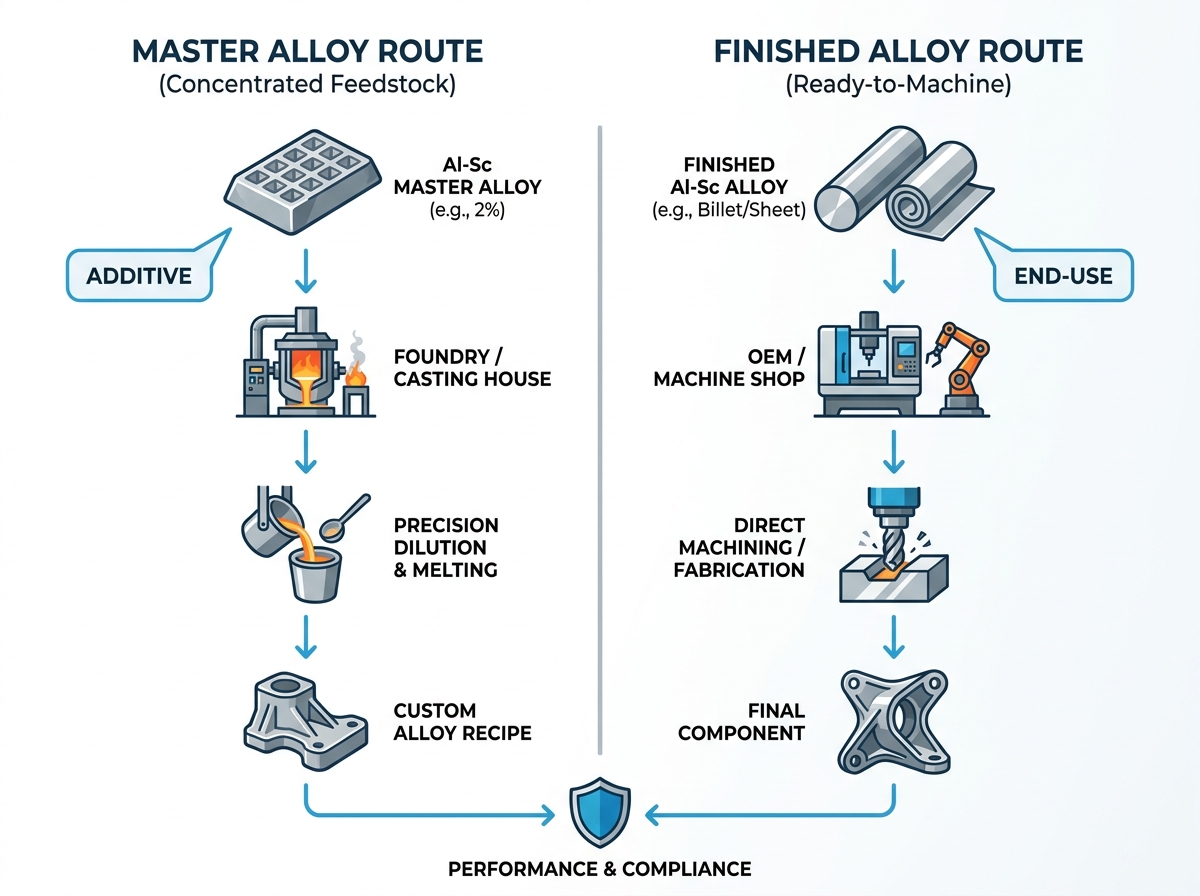
Master alloys are concentrated feedstock (e.g., Al-Sc 2%) meant for foundries and casting facilities equipped for precision dilution.
Finished alloys are fully processed, ready-to-machine billets or sheets designed for end-use manufacturing (e.g., aerospace components).
Procurement decisions must factor in your facility's metallurgical capabilities, yield-loss risks during melting, and strict compliance requirements.
The raw material source—specifically metal versus oxide feedstocks—dictates both the baseline cost and purity of the final aluminium scandium alloy.
A master alloy acts as a precise delivery vehicle. It introduces active elements into a larger melt. You cannot machine or forge a master alloy directly. Instead, you use it as a potent grain refiner and strengthener. Standard market concentrations range from 2% to 10% scandium by weight. Manufacturers use these specific ratios for a crucial reason. Scandium drastically alters the liquidus temperature of aluminum. A 2% concentration melts efficiently in standard foundry furnaces. Higher concentrations require specialized, high-heat equipment. They serve purely as an additive feedstock.
A finished alloy represents the final, homogeneously mixed product. Foundries have already diluted the master alloy into a base metal. They typically integrate it into 5000 or 7000 series aluminum. This creates the final aluminium scandium alloy. You buy this material ready for end-use manufacturing. It arrives in highly processed forms. You will see extrusions, forged billets, and rolled plates. You can immediately place these forms into CNC machines. They require no further melting or chemical alteration.
Many buyers make a simple but expensive mistake. They ask brokers for "scandium aluminum" without specifying the manufacturing tier. A broker might ship a master alloy waffle ingot. A standard machine shop cannot process a waffle ingot. They lack the furnaces required to melt and dilute it. Always specify whether you need a chemical additive or a physical manufacturing substrate.
You must understand the inherent expense of rare earth metals. Scandium remains scarce and difficult to extract. Geopolitical supply chains heavily impact procurement stability. A few key regions control the global extraction. This concentration causes price volatility. Foundries must secure stable supply lines. When supply tightens, the cost of both master and finished alloys spikes.
Upstream production dictates your final material cost. You must evaluate the choice between metal versus oxide feedstocks. Oxide feedstocks cost less upfront. However, they require intense downstream purification. Metal feedstocks cost more initially. They provide superior baseline purity. The initial creation of the master alloy depends heavily on this choice.
Feedstock Type | Initial Cost | Processing Complexity | Purity Potential |
|---|---|---|---|
Oxide Feedstock | Lower | High (requires intensive reduction) | Moderate (higher risk of non-metallic inclusions) |
Metal Feedstock | Higher | Low (easier to melt directly) | Excellent (cleaner microstructure) |
Scandium alloys demand a high premium. You must justify this expense through performance. Standard alloys suffice for general manufacturing. You need scandium when critical weight reduction matters. Aerospace engineers use it to replace heavier titanium parts. Military contractors use it for lightweight ballistics. In these sectors, the high cost translates directly to fuel savings and enhanced mobility.
Using master alloys requires immense technical skill. You face severe in-house alloying hurdles. Scandium burn-off is a primary threat. If furnace temperatures spike, the expensive scandium oxidizes and burns away. You lose your investment into the atmosphere. Operators must maintain strict temperature control. They must use protective gas blankets to prevent oxidation.
Integrating high-concentration versus low-concentration master alloys involves complex metallurgy. A 2% master alloy dissolves relatively easily into a standard aluminum melt. A 10% master alloy behaves differently. It possesses a much higher melting point. If you drop a 10% ingot into standard molten aluminum, it might not fully dissolve. It can sink and form heavy sludge at the bottom of the furnace.
Concentration | Melting Point Profile | Dissolution Speed | Furnace Requirement |
|---|---|---|---|
2% Scandium | Similar to base aluminum | Fast and uniform | Standard foundry furnaces |
10% Scandium | Significantly elevated | Slow (requires agitation) | High-temperature, specialized induction |
Casting mistakes carry massive financial penalties. Getting the alloy mix wrong scraps the entire batch. You cannot simply reverse the process. Yield loss happens quickly if operators make errors.
Improper Weighing: Adding too much master alloy causes brittleness.
Poor Agitation: Failing to stir the melt causes elemental segregation.
Temperature Spikes: Overheating the melt burns off the active scandium.
Slow Cooling: Incorrect casting speeds ruin the grain structure.
Every scrapped batch wastes thousands of dollars in raw materials. You must evaluate if your team can handle these risks.
You should only purchase master alloys if you meet specific operational criteria. This route is strictly for material processors.
You operate a tier-1 foundry or dedicated casting house.
You own proprietary alloy recipes.
You require custom scandium doping levels for specialized clients.
You have the infrastructure for stringent metallurgical testing.
Your facility conducts spectrometry and micro-structure analysis pre- and post-cast.
Best Practice: Always conduct a pilot melt with a small batch of 2% master alloy before scaling up. This tests your furnace's temperature stability without risking large capital.
Most end-product manufacturers should purchase finished materials. This eliminates the metallurgical risks entirely.
You are an OEM, CNC machine shop, or final component manufacturer.
Your facility lacks controlled melting and casting equipment.
You require guaranteed, immediate mechanical properties.
You need certified yield strength, weldability, and fatigue resistance straight from the mill.
You prefer working with standard billets, plates, or extrusions.
Common Mistake: Machine shops often attempt to save money by outsourcing master alloy dilution to uncertified local foundries. This frequently results in porous, unusable billets.
Highly regulated industries demand flawless traceability. You cannot sell components to commercial aviation or defense sectors without proof of quality. Mill Test Certificates (MTCs) provide this proof. When you buy finished alloys, the producing mill issues an MTC. It details the exact chemical composition. It proves the material meets mechanical strength requirements. Without an MTC, your material holds zero value in aerospace applications.
Master alloy quality varies wildly between suppliers. You must audit your supplier's purity verification processes. Look for low interstitial impurities. High levels of iron or silicon ruin the final material. They disrupt the fine grain structure that scandium creates. Ask suppliers for independent lab assays. Ensure they filter out harmful trace elements during extraction.
Industry standards govern exact scandium additions. Organizations like ASTM international set strict limits for aerospace-grade aluminum. You must align your procurement specs with these engineering requirements. Do not accept "approximate" alloy grades. Specify the exact series and temper. Ensure the supplier guarantees compliance with the latest aerospace material specifications.
Your position in the manufacturing supply chain strictly dictates your purchasing choice. Foundries buy master alloys to create custom metal batches. CNC machine shops buy finished alloys to cut parts. Misunderstanding this difference causes severe operational failures. You must protect your capital and production timelines by choosing the correct format.
Next Steps:
Conduct a thorough internal audit of your melting and temperature control capabilities.
Do not request quotes for master alloys if you lack spectrometry equipment.
Request sample billets from finished alloy suppliers to test machining feeds and speeds.
Review your end-client contracts to confirm exact material certification requirements.
A: The core issue revolves around melting point mechanics. Higher scandium content drastically raises the liquidus temperature of the master alloy. This makes it much harder for standard foundries to dissolve the ingot. If operators try to melt a 10% alloy, they risk overheating the base aluminum. A 2% concentration balances efficient dissolution with adequate scandium delivery.
A: Yes, it can. While the final chemistry might look identical on paper, oxide feedstocks carry risks. If foundries do not process them correctly, they introduce trace non-metallic inclusions. These microscopic defects create weak points in the metal matrix. In demanding aerospace applications, these inclusions significantly reduce the component's fatigue life.
A: Yes. One of the primary commercial advantages of finished Al-Sc alloys is their exceptional weldability. Unlike traditional high-strength aluminum series, scandium alloys strongly resist hot cracking. The scandium precipitates during the welding process, helping to retain the structural integrity and strength of the joint.
A: Price gaps stem directly from the extraction source and purification levels. Cheaper suppliers often fail to filter out other rare earth impurities. They might use lower-grade reduction processes. Premium suppliers charge more because they guarantee high purity, low iron content, and precise scandium ratios, ensuring your final cast succeeds.


