
close
Choose Your Site
Global
Social Media


Views: 0 Author: Site Editor Publish Time: 2026-10-10 Origin: Site


Sourcing high-purity rare earth materials often challenges even the most seasoned procurement teams. Specific technical demands drive the global procurement of Pr6O11 across multiple advanced industries. You need precise specifications to ensure optimal end-product performance. Pr6O11 represents the most stable phase of praseodymium oxide under ambient conditions. This unique compound features a complex mixed-valence chemistry. It combines distinct oxidation states to deliver exceptional oxygen mobility. We wrote this guide to translate complex material science into actionable procurement criteria. It will help technical buyers evaluate crucial specifications confidently. You will learn how to navigate intricate global supply chains effectively. We also cover practical strategies to mitigate common sourcing risks. By understanding these core chemical advantages, you can make smarter, data-driven purchasing decisions. Let us explore the exact parameters you should prioritize when evaluating your next bulk supplier contract.
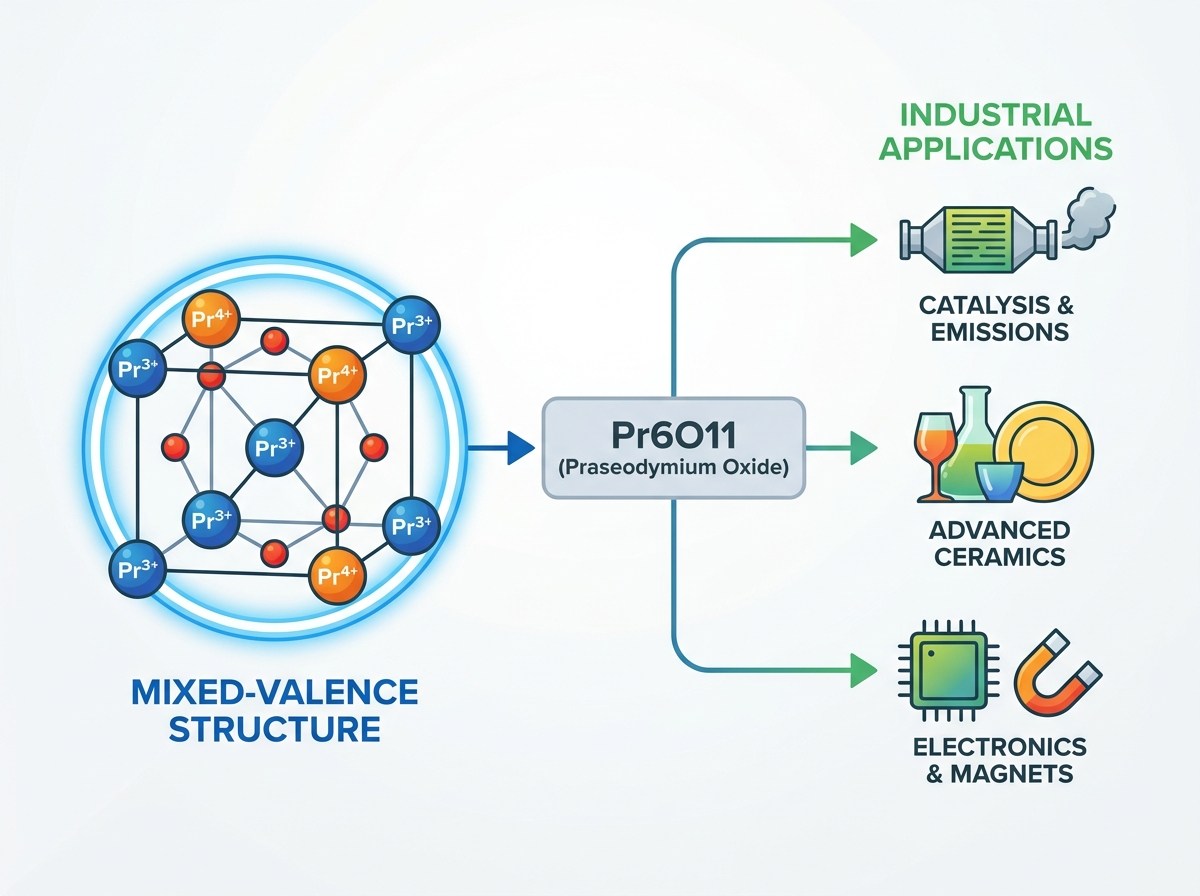
Chemical Uniqueness: Pr6O11 contains both Pr(III) and Pr(IV) oxidation states, a mixed-valence structure that is critical for advanced catalytic and electronic applications.
Specification Matrix: Selecting the right product requires matching physical properties (like D50 particle size and surface area) and purity levels (ranging from 99% to 99.999% TREO) to the end-use application.
Procurement Verification: Consistent batch-to-batch quality requires rigorous evaluation of Certificates of Analysis (COAs), specific impurity thresholds, and secure, moisture-resistant packaging.
Sourcing Strategy: Reliable procurement demands assessing supplier transparency, upstream traceability, and capacity for custom particle sizing.
Procurement teams must first grasp the fundamental chemistry of Pr6O11. Chemical structure directly dictates industrial performance. Understanding these properties prevents costly sourcing errors.
Industry standards identify Pr6O11 by CAS No. 12037-29-5. It presents visually as a dark brown-black powder. This dark coloration distinguishes it clearly from other praseodymium compounds. For instance, the strictly trivalent phase (Pr2O3) typically appears pale green. Pr6O11 remains highly stable at room temperature. Its stability simplifies bulk storage and transport logistics. Buyers usually specify this exact phase for most industrial orders.
The true value of Pr6O11 lies in its internal structure. The compound forms a specific fluorite-type crystal lattice. This lattice accommodates both Pr3+ and Pr4+ ions simultaneously. The dual presence creates a mixed-valence state. Alternating ionic charges naturally generate localized oxygen vacancies within the crystal matrix. These microscopic vacancies act like highways for oxygen atoms. Oxygen moves freely and rapidly through the material. This internal mobility represents a massive advantage for advanced engineering applications.
How does this chemistry improve commercial products? The high oxygen mobility translates directly into superior oxygen storage capacity (OSC). Catalytic converters rely heavily on OSC to function. Pr6O11 can absorb excess oxygen from an environment. It can then release oxygen back when levels drop. This dynamic buffering effect stabilizes chemical reactions. Single-valence alternatives lack this inherent flexibility. Therefore, manufacturers choose the mixed-valence state to guarantee peak catalytic efficiency. You pay a premium for this specific structural capability.
Different industries leverage Pr6O11 for varying technical reasons. You must align your procurement specifications with your final application.
The automotive industry consumes significant volumes of this material. Modern catalytic converters require stable oxygen environments. Pr6O11 regulates the air-to-fuel ratio dynamically during exhaust treatment. It stores oxygen during lean burn cycles. It releases oxygen during rich burn cycles. This buffering capability reduces harmful tailpipe emissions significantly. Chemical synthesis plants also use it as a robust promoter. It enhances the efficiency of primary industrial catalysts.
Ceramic manufacturers value the intense coloration properties. Pr6O11 serves as a fundamental ingredient for yellow-green ceramic pigments. These pigments withstand extremely high firing temperatures without degrading. The glass industry utilizes it for specialized optical products. Safety goggles for welding incorporate praseodymium to filter specific harsh light wavelengths. It blocks dangerous infrared radiation while maintaining high visible light transmission.
The electronics sector demands highly engineered rare earth powders. Solid-oxide fuel cells (SOFCs) use Pr6O11 to improve electrode conductivity. Piezoelectric devices rely on its stable dielectric properties. In metallurgy, manufacturers blend it alongside neodymium. The resulting NdPr alloy forms the basis of high-performance permanent magnets. These magnets power electric vehicle motors and modern wind turbines. The purity requirements in these sectors remain exceptionally strict.
Emerging technologies increasingly demand nano-grade praseodymium powders. Advanced material science utilizes these nano-particles for high-tech gas sensors. The immense surface-area-to-volume ratio of nano-powders drastically increases chemical reactivity. Sensor devices detect trace gases much faster using this enhanced reactivity. Procurement of nano-scale material requires intensive supplier vetting due to strict physical tolerances.
Chemical purity only tells half the story. Buyers must evaluate multiple distinct metrics before approving a purchase order. Understanding various rare earth oxide grades ensures you avoid overpaying for unnecessary specifications.
Total Rare Earth Oxide (TREO) serves as the primary purity benchmark. Commercial grade praseodymium typically hits 99% TREO. This level suits basic ceramic pigments perfectly. High purity grades range between 99.9% and 99.99%. Automotive catalysts and specialized glass require this tighter specification. Ultra-high purity grades reach 99.999%. Electronic components and delicate nano-sensors demand this extreme refinement. Higher purity reduces the risk of electronic interference from trace elements.
Grade Level | TREO Purity (%) | Typical Industrial Applications | Key Impurities to Monitor |
|---|---|---|---|
Commercial Grade | 99.0% | Ceramic pigments, basic metallurgy | La, Nd, Fe, Ca |
High Purity | 99.9% - 99.99% | Catalytic converters, optical glass | Nd, Ce, Sm, Si |
Ultra-High Purity | 99.999% | Solid-oxide fuel cells, nano-sensors | Trace heavy metals, Al, Mg |
Chemical purity is never enough for advanced manufacturing. Buyers must evaluate critical physical parameters carefully. Particle Size Distribution (PSD) dictates how the powder behaves during production. The D50 metric indicates the median particle diameter. Specific surface area (BET) measures the total exposed surface of the particles. Catalysis applications demand high BET values for maximum reactivity. Bulk density impacts your storage space and transportation costs. You must define these physical parameters clearly in your supplier contracts.
Trace impurities cause significant manufacturing defects. You must identify allowable limits for specific contaminants. Trace rare-earth elements frequently survive the refining process. Neodymium (Nd) and Lanthanum (La) often carry over from raw ore. Non-rare-earth impurities like Iron (Fe) and Calcium (Ca) disrupt electromagnetic properties. Strict end-product requirements dictate your impurity tolerance. Magnets tolerate some neodymium presence naturally. However, optical glass fails instantly if iron levels exceed strict microscopic thresholds.
Define exact D50 and D90 parameters before requesting vendor quotes.
Match your purity requirements strictly to your final application to control costs.
Establish clear maximum thresholds for troublesome trace metals like iron or silicon.
Ordering 99.999% purity for basic ceramic pigments wastes procurement budget.
Ignoring bulk density metrics often leads to unexpected shipping surcharges.
Failing to specify BET surface area can ruin catalytic converter performance.
Procuring raw materials involves managing significant logistical and safety variables. Pr6O11 introduces unique handling requirements into your facility operations.
Standard industrial safety protocols apply strictly here. You must review the Safety Data Sheet (SDS) thoroughly. Pr6O11 generally remains stable under normal warehouse conditions. However, fine industrial powders always present occupational hazards. Dust inhalation frequently causes respiratory irritation among factory workers. Direct powder contact can provoke mild skin irritation over time. Facility managers must enforce proper PPE usage. Workers require industrial dust masks, heavy gloves, and sealed eye protection during handling.
Improper packaging degrades raw material quality rapidly. Pr6O11 exhibits hygroscopic tendencies over extended periods. It actively absorbs moisture from humid air. Absorbed moisture clumps the powder and alters its precise mass. Suppliers must utilize strict moisture-proof packaging protocols. Standard practice requires heavy-duty vacuum-sealed polymer bags. Workers place these sealed bags inside rigid steel drums. You should reject shipments showing any signs of broken seals or drum damage.
Global rare earth markets experience frequent pricing shifts. Geographic concentration of mining operations causes inherent supply chain volatility. A few key regions dominate raw ore extraction and chemical refining. This concentration exposes buyers to sudden geopolitical disruptions. You must diversify your supplier base actively. Relying on a single regional distributor invites catastrophic production delays. Savvy procurement teams verify upstream mineral sourcing constantly. Transparent traceability ensures your supply remains stable despite broader market fluctuations.
Selecting a reliable chemical supplier minimizes downstream manufacturing headaches. Use a structured evaluation process to qualify potential vendor partners effectively.
Supplier transparency separates reliable partners from risky brokers. You must demand comprehensive documentation upfront.
Require Batch-Specific COAs: A standard Certificate of Analysis (COA) is absolutely non-negotiable. The COA must reflect the exact batch you are purchasing. Avoid generic or outdated specification sheets entirely.
Verify Third-Party Lab Testing: The best suppliers validate their COAs through independent laboratories. This step prevents internal data manipulation.
Review Traceability Records: Request origin documentation for the raw rare earth ore. Ethical sourcing compliance requires a transparent upstream supply chain.
Many vendors operate merely as pass-through distributors. True manufacturing partners offer deep technical customization. Evaluate whether a supplier can engineer specific particle sizes. Can they mill bulk material down to exact D50 specifications? Do they possess the technology to produce true nano-powders? Distributors cannot adjust physical properties. They simply resell bulk commodities. Direct manufacturers adjust their chemical processes to meet your exact engineering requirements. You gain significant technical advantages by partnering directly with capable manufacturers.
Never commit to bulk tonnage contracts based purely on paperwork. Always validate material performance physically in your own facility.
Order Pilot Samples: Request small batch samples covering 5 to 10 kilograms initially.
Conduct Internal Lab Testing: Run the samples through your specific manufacturing process. Measure the output quality rigorously.
Verify Batch-to-Batch Consistency: Order a second pilot sample from a different production run. Compare the physical and chemical metrics. Consistent quality across multiple batches indicates a tightly controlled manufacturing environment.
Successful industrial procurement requires balancing complex chemical realities against strict commercial budgets. The mixed-valence structure of Pr6O11 delivers exceptional oxygen mobility and catalytic performance. However, realizing these benefits demands precise specification matching. You must evaluate purity levels, particle size distribution, and specific impurity tolerances rigorously. Remember to prioritize moisture-proof packaging to maintain long-term material integrity.
Take actionable steps to secure your supply chain today. Contact your shortlisted suppliers and demand batch-specific Certificates of Analysis. Review their Technical Data Sheets (TDS) thoroughly. We strongly recommend consulting directly with a materials engineer to verify application fit before finalizing any large purchase order. Proactive validation prevents costly manufacturing defects down the line.
A: Pr6O11 features a mixed-valence state containing both Pr3+ and Pr4+ ions. It appears as a dark brown-black powder and remains highly stable under ambient conditions. Pr2O3 only contains Pr3+ ions. It typically appears pale green and acts more reactively in atmospheric environments. Industry prefers Pr6O11 for bulk stability.
A: No, stable praseodymium is not radioactive. It is a naturally occurring stable element. However, raw rare earth ores often contain trace amounts of radioactive thorium or uranium. Reputable refiners remove these dangerous elements entirely during the extraction process. Always request a COA to verify safe purity levels.
A: The globally recognized standard CAS number for Pr6O11 is 12037-29-5. Buyers should always use this exact CAS number on purchase orders. It ensures suppliers provide the correct mixed-valence phase rather than alternative, less stable praseodymium compounds.
A: Store the powder in cool, dry, and well-ventilated conditions. The material exhibits hygroscopic properties over time. You must keep it in tightly sealed, moisture-proof containers. Factory floors should utilize vacuum-sealed bags placed inside sturdy steel drums to prevent contamination and degradation.
A: Yes, particle size directly impacts market pricing. Highly engineered nano-powders require extensive processing and strict quality control. These fine grades command a significant premium over standard milled bulk grades. You should only pay for nano-grades if your application strictly requires high surface area reactivity.


